 CN Sweaters
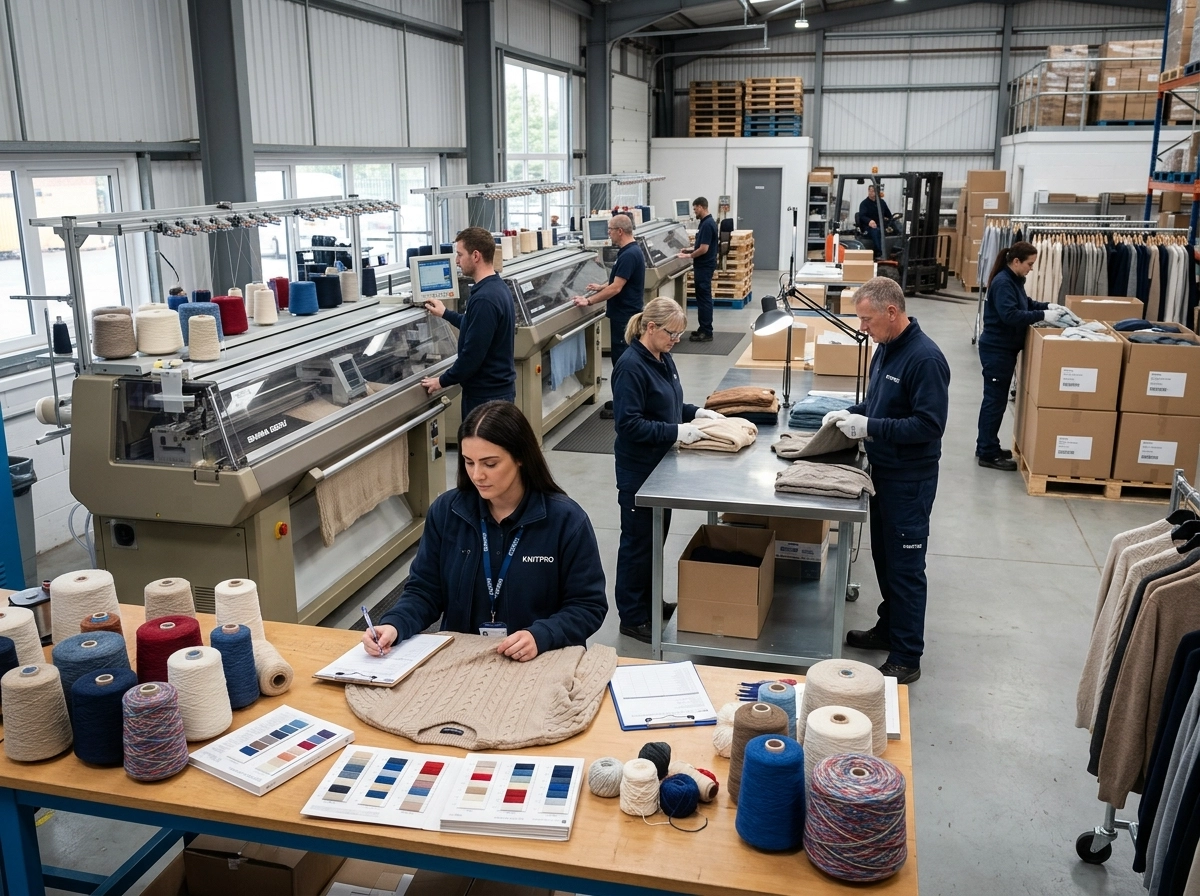
If you are sourcing factory sweaters for a brand, wholesale program, or replenishment order, the real question is not simply how a sweater is made. The real question is whether a sweater factory can control the process well enough to deliver stable bulk quality, predictable lead times, and repeatable results across colors and reorders.
From a factory perspective, sweater production is not one long knitting step. It is a chain of technical decisions that starts with yarn planning and ends with packing, labeling, and shipment control. If one stage is weak, the bulk result usually suffers later in measurements, hand-feel, seam appearance, shade consistency, or delivery timing. That is why buyers should look at the entire production line, not just the sample on the table. Source Source
For buyers comparing a sweater factory, this article explains what happens from yarn to finished garment, where the common risks are, and what checkpoints matter most before placing a bulk order. It is written for brands, wholesalers, distributors, procurement teams, and product developers who need factory-level clarity rather than generic fashion content.
What Happens Before Knitting Starts
Before a machine begins knitting, many of the most important production outcomes have already been shaped. In knitwear, yarn choice, gauge, stitch structure, and sample approval all influence cost, lead time, consistency, and how safe a style will be in bulk.
Yarn selection shapes cost hand-feel and delivery risk
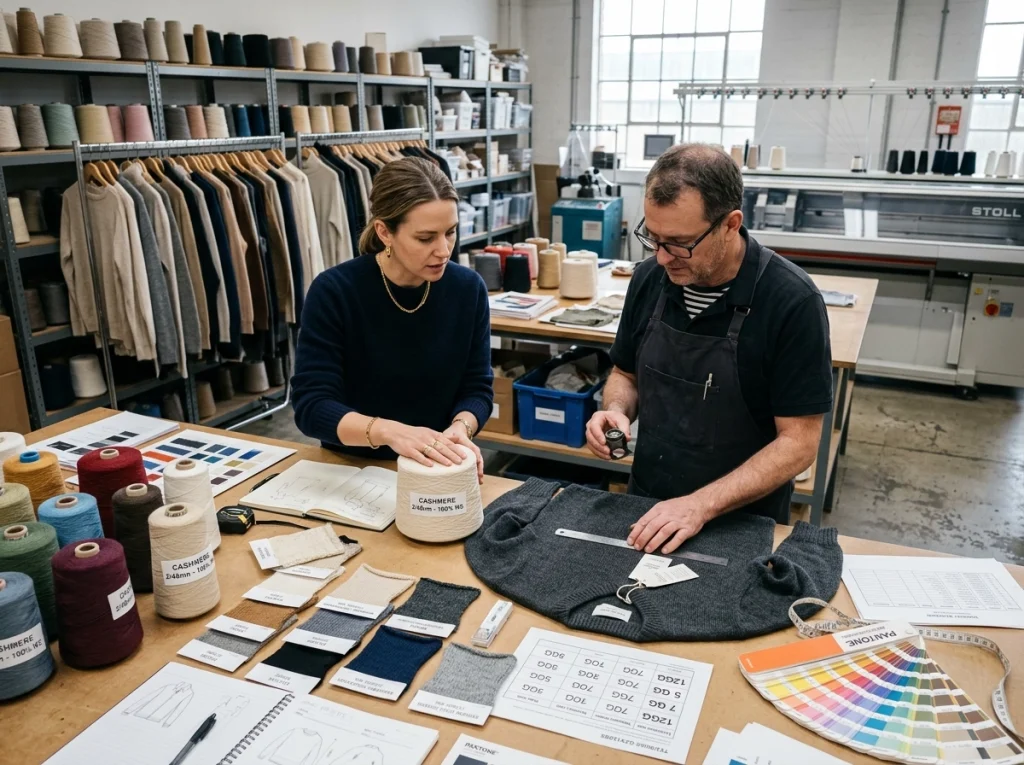
Yarn is not only a material decision. It affects hand-feel, appearance, pilling tendency, color continuity, minimum order flexibility, and how quickly a factory can move from sample to bulk. A sweater may look commercially attractive in development, but if the yarn is unstable, hard to replenish, or difficult to match across lots, the production risk increases.
For buyers, this means the right yarn is not always the softest or most premium-looking option at first touch. In many programs, the better decision is the yarn that balances feel, cost target, color repeatability, and lead time. That is especially true for repeat styles and wholesale programs where consistency matters more than a one-off showroom sample.
A reliable sweater factory should also be able to explain whether the yarn is in-stock, custom dyed, or likely to require early booking for peak season. That level of transparency is often more useful than a broad promise about “high quality materials.” On the OEM / ODM knitwear service page, cnsweaters also highlights yarn matching, color control, and archived lot records as part of production consistency, which is exactly the kind of operational detail buyers should look for. Source
Gauge and stitch decisions affect both look and production stability
Gauge affects more than fabric weight. It changes the visual texture, stretch behavior, thermal feel, production speed, and tolerance sensitivity of the finished garment. A chunky 3GG to 5GG style behaves very differently from a 12GG to 14GG sweater in both development and bulk execution. The same is true for stitch choice: a clean jersey structure is much easier to stabilize in production than a complex jacquard, cable, pointelle, or mixed-texture construction. Source
From a buyer’s point of view, the practical issue is simple. The more complex the stitch and the finer the tolerance expectation, the more important machine setup, technician judgment, and sample approval become. A style can be visually impressive but still be a weak bulk candidate if the structure is too sensitive to yarn variation or difficult to control at scale.
This is why strong factories do not treat gauge and stitch as decorative choices only. They treat them as production variables tied to cost, output efficiency, defect risk, and delivery planning. That approach is more useful for commercial sourcing than a design-first conversation with no production filter.
Sampling turns design intent into production instructions
Sampling is where a design stops being an idea and starts becoming a real production standard. In sweater manufacturing, a sample should confirm fit, gauge direction, stitch feasibility, yarn suitability, construction method, color approach, and finishing effect before the bulk line is planned.
This stage matters because many sweater issues are not fully visible in a sketch or tech pack. A buyer may approve a silhouette, but the factory still needs to prove that the style can be knitted, linked, washed, measured, and packed consistently. That is why the sample stage should not only focus on appearance. It should also answer whether the style is scalable.
On cnsweaters’ sweater manufacturing page and custom knit projects page, the workflow is framed around consultation, sample validation, technical evaluation, and risk control before bulk. That logic is sound. In knitwear, the sample is not just a preview of the garment. It is the first serious test of the production line behind it. Source Source
How Sweater Panels or Bodies Are Made on the Knitting Floor
Once development is confirmed, the knitting floor turns specifications into physical components. This stage decides whether the factory can convert approved standards into stable output, not only whether it owns the right machines.
Construction method changes quality cost and finish
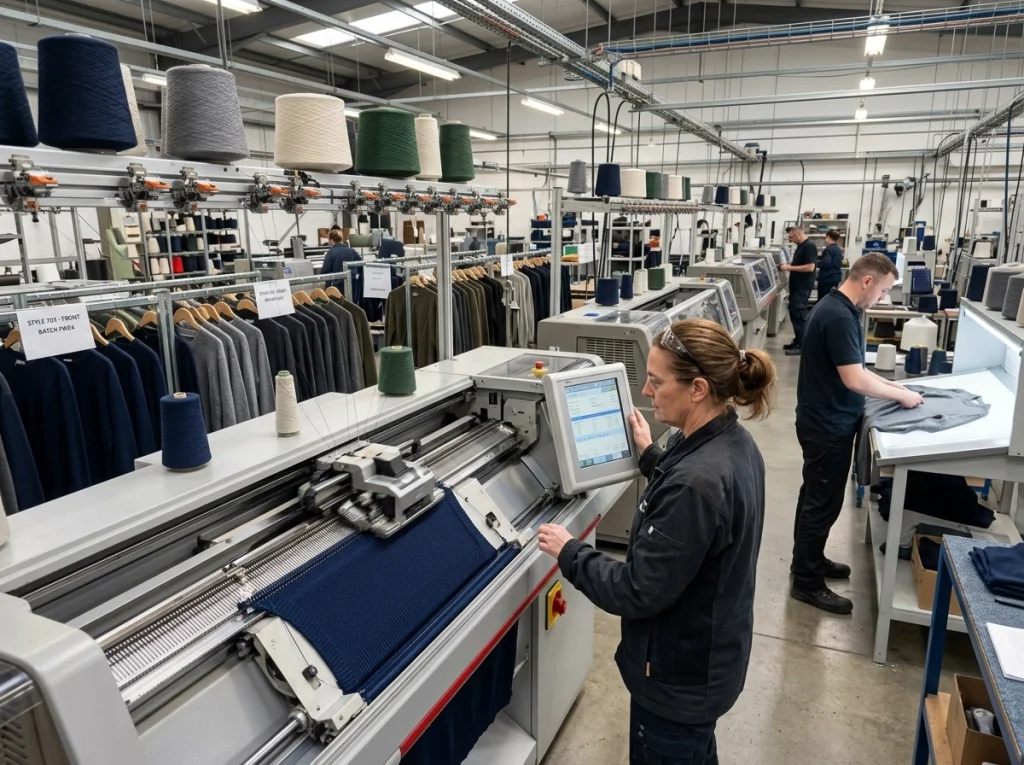
Not all sweaters are built the same way. Some programs use fully fashioned construction, where panels are shaped directly on the knitting machine and then linked together. Others use cut-and-sew methods or other construction choices depending on cost, silhouette, and design needs. Each method has trade-offs in seam appearance, fit control, labor input, and perceived quality. Source
Fully fashioned construction is often preferred for better shape definition and cleaner knitwear finishing. However, that does not mean it is automatically the right choice for every commercial program. Some styles are more price-sensitive, some are trend-driven, and some have simpler lifecycle expectations. Buyers should judge the method by the market goal, not by one fixed hierarchy.
What matters most is whether the factory can explain why it is recommending a construction method and how that choice affects cost, appearance, and production risk. When a supplier cannot explain that clearly, the buyer is left with a sample but not a process.
Machine setup and programming matter more than buyers often think
A sweater factory does not produce stable output simply because it has knitting machines on the floor. Programming, machine calibration, yarn feeding control, and operator handling all affect panel consistency. In practice, two factories can run a similar style but produce very different results depending on how carefully the knitting setup is managed.
This is particularly important for styles that involve multiple sizes, repeating patterns, or color changes. If programming and setup discipline are weak, the problems may first appear as panel mismatch, unstable dimensions, irregular tension, or avoidable rework. Those are not always visible in a polished sample, but they often surface during bulk.
That is why buyers should pay attention to whether the factory talks about machine capability in a technical way or only uses it as a sales term. A capable sweater factory should connect machine setup to output consistency, not just to speed.
Knitting defects should be caught before assembly
The knitting stage is where many problems are cheapest to catch and most expensive to ignore. Missed stitches, pattern errors, tension instability, yarn contamination, and panel mismatch can often be corrected earlier if the line is monitored closely. Once garments move into linking, washing, finishing, and packing, the same problem becomes slower and more costly to fix.
From a procurement standpoint, this is why inline control matters. A factory that only relies on final inspection is already too late for many knitwear issues. Good sweater production depends on finding and isolating errors while the line is still moving, not after the cartons are nearly ready.
How Knitted Parts Become a Shipment-Ready Garment
Knitted panels are not yet a finished sweater. The garment only becomes commercially usable after linking, sewing, trimming, washing, finishing, measurement review, and packing are completed in a controlled sequence.
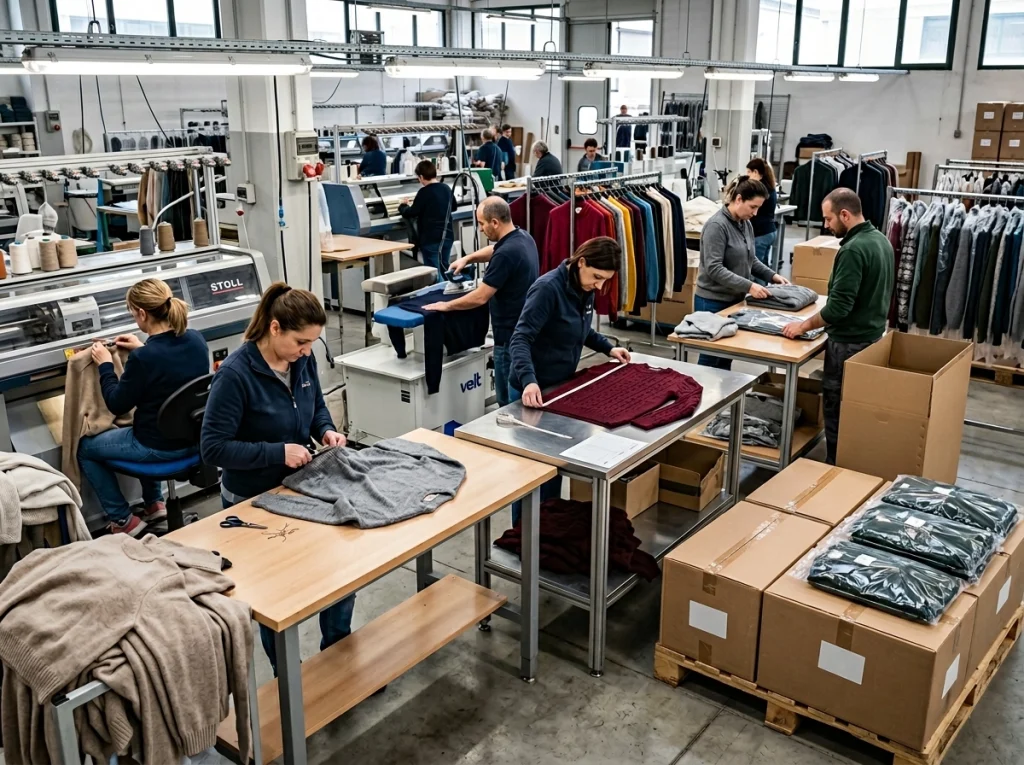
Linking sewing and trimming define seam quality
Linking is one of the clearest signs of knitwear workmanship. It affects seam appearance, comfort, shape holding, and how premium the garment feels in hand. Clean linking and careful assembly help a sweater look intentional and stable. Poor linking makes even a good yarn and a good design look weak.
Buyers sometimes focus heavily on knit structure and overlook seam execution. In reality, seam quality can strongly influence return rates, customer perception, and brand trust. Loose ends, unstable joins, and sloppy edge finishing may seem minor in isolation, but in bulk they quickly signal poor control.
On the cnsweaters homepage, the factory highlights calibrated knitting, skilled linking, and dedicated inspection points between production and shipment. That kind of process visibility is useful because knitwear quality is often won or lost in assembly and finishing, not just in knitting. Source
Washing steaming and finishing set the final look and measurement
In sweater production, washing and finishing are not cosmetic afterthoughts. They are part of how the garment reaches its final hand-feel, drape, measurement behavior, and surface appearance. The same style can look materially different before and after finishing, which is why sample approval should consider the post-finish result rather than the knitted state alone.
This is also where buyers need realistic expectations. A sample that looks right before wash does not guarantee that the finished bulk will behave the same way if the yarn, stitch density, or finishing parameters shift. Knitwear is especially sensitive because softness, elasticity, and dimensional stability are closely tied to finishing control.
That is one reason factory records matter so much. If the approved sample was washed and finished one way, the bulk process needs to follow the same standard closely. Otherwise, the garment may still look “similar” but drift in feel, measurement, or surface quality.
Labeling packing and carton control reduce shipping mistakes
By the time a sweater reaches the packing table, most buyers assume the hard work is done. In reality, export packing is one of the final risk points that can still create expensive problems. Wrong size stickers, barcode mistakes, missing labels, inconsistent folding, carton ratio errors, and weak moisture protection can all damage an otherwise successful order.
For wholesale and distribution programs, this step matters because warehouse receiving depends on accuracy. If carton marking, size breakdown, or packing lists are wrong, the problem becomes operational very quickly. It affects receiving efficiency, inventory confidence, and downstream fulfillment.
The cnsweaters site places visible emphasis on labeling, polybags, cartons, and shipment documentation, and that is appropriate. For bulk knit sweaters, packing is not a back-office detail. It is part of order execution. Source Source
Where Bulk Knit Sweaters Usually Go Wrong
Bulk knit sweaters usually do not fail because of one dramatic mistake. More often, problems build slowly across the line through small inconsistencies in yarn, setup, measurements, finishing, or documentation.
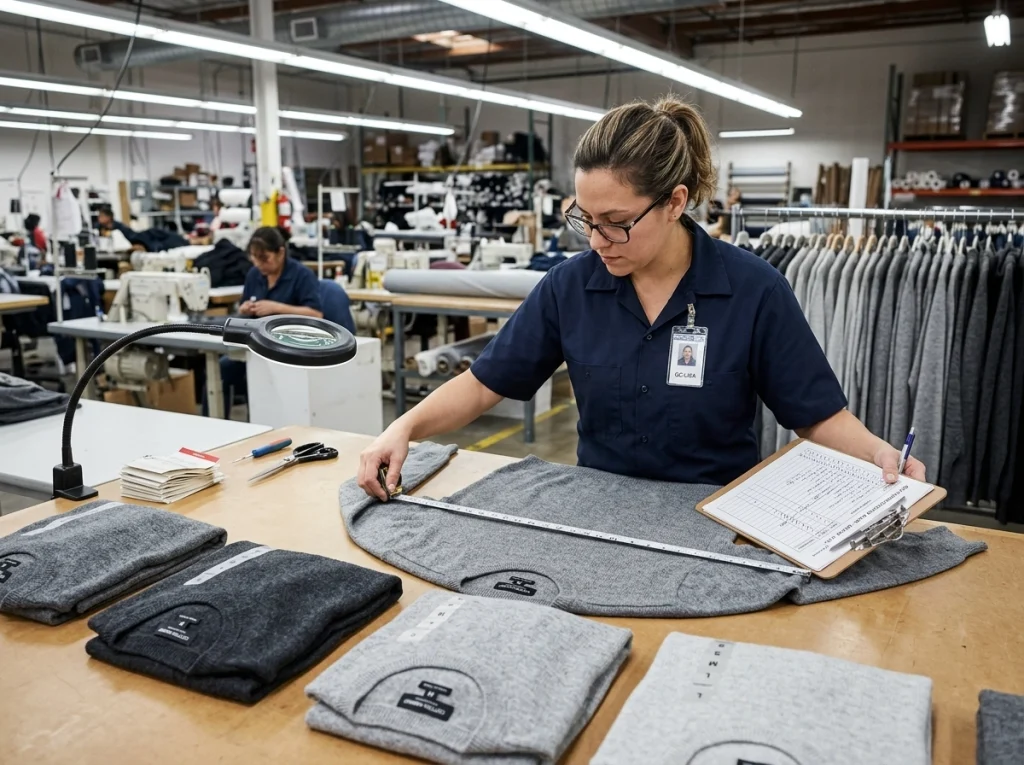
Shade variation measurement drift and pilling risk
Three of the most common knitwear problems are shade variation, measurement drift, and surface performance issues such as pilling. These are not random defects. They usually come from weak control in yarn lots, inconsistent knitting tension, unstable finishing, or poorly defined approval standards.
This is why buyer conversations should go beyond “Do you inspect quality?” and into “How do you control color continuity?” “What happens if measurements drift during bulk?” and “How do you evaluate surface behavior against the approved standard?” Those are much better sourcing questions than a generic request for assurance.
The value of a factory perspective is that it does not pretend these risks disappear. It explains where they come from and how they are managed. That is a stronger trust signal than a perfect-sounding promise.
Inline QC and final AQL reduce surprises
Inline quality control is usually the first real protection against bulk surprises. It helps catch process problems while corrections are still possible. Final inspection is still necessary, but it works best as a confirmation layer rather than the main control method.
Many apparel buyers use AQL as part of final inspection planning. QIMA’s guidance explains AQL as a sampling method used to determine the maximum acceptable number of defects in an inspected lot. That makes it useful for shipment decisions, but it should not be confused with full process control. AQL can help accept or reject a lot. It cannot replace disciplined production management. Source
The same logic appears on cnsweaters’ service pages, where inline checks and final AQL are presented together. That is the right structure. In knitwear, final inspection alone is rarely enough if the line has already drifted. Source
| Production Stage | What Buyers Should Check | Common Risk |
|---|---|---|
| Yarn planning | lot continuity, color approach, replenishment feasibility | shade mismatch, delays |
| Sampling | fit, stitch feasibility, finishing result | bulk not matching sample |
| Knitting | machine consistency, panel quality, defect handling | tension issues, pattern errors |
| Linking and finishing | seams, loose ends, final hand-feel, measurements | poor appearance, size drift |
| Packing and shipment | labels, barcode, carton ratio, packing list | receiving errors, claim risk |
Repeat orders depend on records not memory
A repeat order is where a factory proves whether it really controls its process. If the first order looked acceptable only because one technician remembered the details, the second order may drift. If the factory has proper yarn records, approved sample standards, size comments, finishing notes, and labeling references, the repeat program is much safer.
For buyers, this matters more than many realize. Stable replenishment does not come from good intentions. It comes from traceable standards and disciplined record keeping. That is why factories that archive yarn lots, color references, and approval benchmarks are usually more reliable partners for long-term programs. Source
How Buyers Should Read a Sweater Factory Production Line
When buyers visit or evaluate a sweater factory, they should not focus only on how many machines are on the floor. The more useful question is whether the factory can connect development, knitting, finishing, QC, and shipment into one controlled system.
Questions buyers should ask before placing bulk
A serious buyer should ask what yarn options are realistic for the timeline, how gauge and construction were chosen, what the sample actually confirmed, and how the factory manages color and measurement consistency in bulk. It is also worth asking what part of the process is most likely to delay the order if a style is more complex than it looks.
Questions about replenishment are just as important. Can the supplier support repeat yarn continuity? Does it keep records from the approved sample? How does it manage style stability across seasons or replenishment cycles? These questions reveal whether the factory thinks in transactions or in programs.
If you are comparing suppliers, pages such as OEM / ODM knitwear service, sweater manufacturing, and custom knit projects can also help frame what type of discussion you should be having with a factory before you move into bulk.
When a lower MOQ makes sense and when it does not
Low MOQ sounds attractive, but it is not always a sign of a better sourcing option. In some cases, a lower MOQ works because the yarn is already available, the stitch is stable, and the factory is planning around a practical machine setup. In other cases, pushing MOQ too low can increase unit cost, reduce production efficiency, or create avoidable inconsistency.
A good factory should be able to explain that trade-off clearly. Buyers do not need every order to have the lowest possible MOQ. They need the MOQ that makes commercial sense for the product, timing, and quality expectation.
That is especially true for bulk knit sweaters with multiple colors or heavier technical requirements. A small quantity may still be possible, but it may not be the most efficient or safest production path.
What a reliable factory should confirm before shipment
Before shipment, the factory should be able to confirm that the bulk matches the approved standard in measurements, appearance, labeling, and packing execution. It should also be clear whether the final result reflects the same finish standard used during sample approval.
If the program is likely to repeat, the factory should already know what needs to be archived for the next order. That includes yarn and shade references, approved sample comments, trim details, and the final packing standard. When that discipline is in place, buyers can plan with much more confidence.
Conclusion
A reliable sweater factory is not defined by how many production steps it can list. It is defined by how well it controls each step from yarn planning to final shipment.
For buyers, that means the safest sourcing decision is usually not the supplier with the most polished sample or the broadest promises. It is the supplier that can explain why the yarn works, how the sample was validated, where bulk risks usually appear, and what controls are in place before goods leave the factory.
If you are reviewing factory sweaters for a new program or replenishment line, focus on process control as much as product appearance. That is what protects lead time, quality stability, and reorder confidence. If you want to evaluate a production workflow in more detail, you can start with the cnsweaters homepage, review its OEM / ODM knitwear service, or explore its sweater manufacturing capabilities to compare how development, bulk production, and shipment are handled.
FAQ
What is the most important stage in sweater production for buyers?
The most important stage is usually the transition from sample approval into bulk planning. That is where yarn, gauge, construction, finishing expectations, and quality checkpoints must be aligned. If this step is weak, the order may still move forward, but bulk consistency becomes much harder to protect.
How do sweater factories control color consistency in bulk orders?
The short answer is through yarn lot control, approval standards, and process discipline. Color consistency is easier to maintain when the factory tracks yarn continuity, confirms lab dip or shade direction early, and keeps the approved benchmark visible during bulk. Source
What usually causes delays in bulk knit sweater production?
The most common causes are late yarn decisions, stitch or construction changes after sampling, unresolved size comments, and weak capacity planning during peak season. In knitwear, even a small technical adjustment can affect machine planning, finishing, and shipment timing.
Why can a sample look right while bulk production still fails?
Because a sample proves only part of the process unless it is tied to clear production standards. A sample may look correct, but bulk can still drift if yarn lots change, finishing is not repeated consistently, or inline quality control is weak. That is why sample approval should be treated as a production reference, not only as a visual sign-off.
What should buyers confirm before approving shipment?
Buyers should confirm measurements, appearance, seam quality, labeling accuracy, packing ratio, and whether the final finish matches the approved standard. If the order may repeat, they should also confirm that the factory has archived the right records for replenishment.
External References
- Scribd — Sweater Manufacturing Industry Process Guide — https://www.scribd.com/document/878166728/Sweater-Manufacturing-Industry-Process-Guide
- QIMA — Acceptable Quality Level, AQL Sampling Chart and Calculator — https://www.qima.com/aql-acceptable-quality-limit
- QIMA Blog — Garment Quality Control & Inspection Procedures — https://blog.qima.com/inspection/garment-quality-inspection-procedures
- OEKO-TEX — OEKO-TEX STANDARD 100 — https://www.oeko-tex.com/en/our-standards/oeko-tex-standard-100/