 CN Sweaters
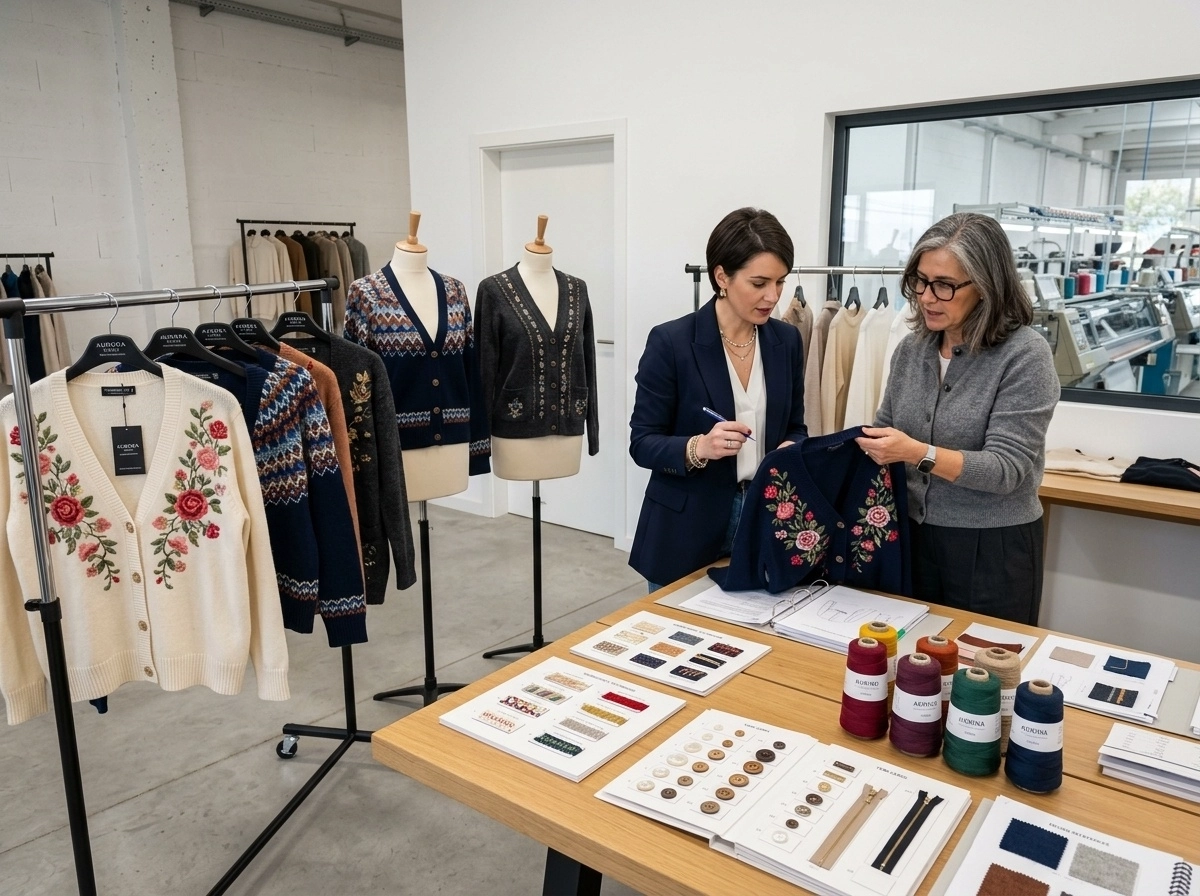
A custom embroidered cardigan collection adds value when embroidery is planned as part of the product strategy, not added at the end as decoration. For brands, wholesalers, and product teams, the real upside is not just visual detail. It is stronger line identity, clearer price segmentation, better retail presentation, and a collection that is easier to sample, produce, and reorder.
This matters most for buyers who are building knitwear with a commercial objective. If you are comparing a plain cardigan program with a more design-led one, the right question is not whether embroidery looks attractive. The better question is whether it improves the collection’s sell-through potential without creating avoidable risk in development, bulk production, or replenishment. From a factory perspective, that is where an embroidered cardigan program either becomes a smart value-add or an expensive distraction.
Why embroidery can add more value to cardigans than to basic knits
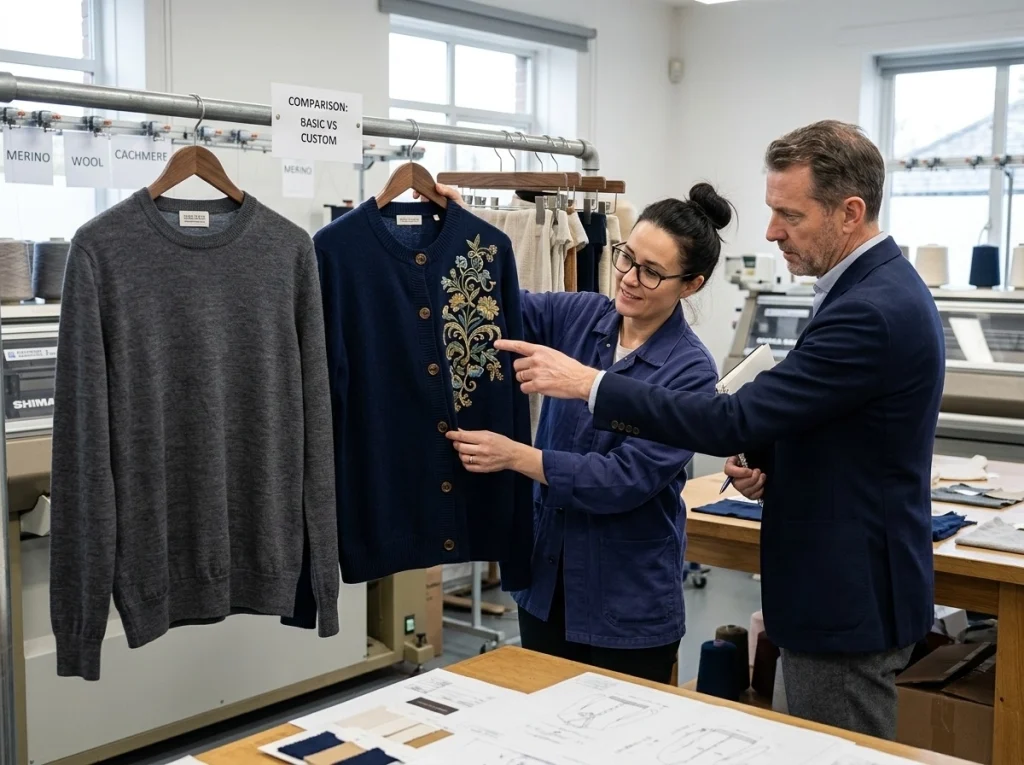
Embroidery often creates more value on cardigans than on basic knit tops because a cardigan already has stronger structure, more styling flexibility, and more visible commercial touchpoints. When the base garment is right, embroidery can raise the perceived value of the piece without forcing the entire collection into a high-risk development path.
A cardigan gives embroidery more merchandising visibility
A cardigan naturally gives embroidery more room to work. Unlike a basic pullover, it has a front opening, placket, buttons, pocket zones, and more layering potential. That means a small embroidered detail can change how the garment reads at retail without requiring a full graphic treatment.
This is especially useful for brands that need a recognizable but controlled signature. A chest motif, cuff detail, crest, tonal logo, or back-neck embroidery can create distinction while keeping the body commercially wearable. On a well-developed knitted cardigans program, the garment already carries enough structure for embroidery to feel integrated rather than added on.
Cardigans support a wider price ladder
A cardigan collection also gives buyers more room to build a price architecture. A plain core cardigan can sit at the entry point. A similar body with embroidery can move into a higher-value tier. A more developed version with upgraded yarn, custom buttons, and branded packaging can move further up again.
That matters because embroidery works best when it supports merchandising, not when it tries to carry the whole product story alone. In commercial terms, embroidery is useful because it creates a visible reason for price differentiation. It can help explain why one style is more premium than another without forcing a brand to change the entire construction, silhouette, or fit block.
Embroidery works best when it supports the silhouette, not when it fights it
Not every cardigan is a good candidate for embroidery. The base needs to support the decoration. If the yarn surface is too fuzzy, the gauge is too unstable, or the placket area lacks control, embroidery can create puckering, distortion, or uneven appearance. In those cases, embroidery may add cost without adding real value.
The best results usually come when the silhouette, yarn, stitch structure, and embroidery idea are aligned from the beginning. A clean surface, stable panel, and clear placement zone generally produce better outcomes than a heavily brushed, highly textured, or loosely balanced knit. That is why embroidery should be treated as part of the product engineering conversation, not just the design conversation.
What makes an embroidered cardigan collection commercially stronger
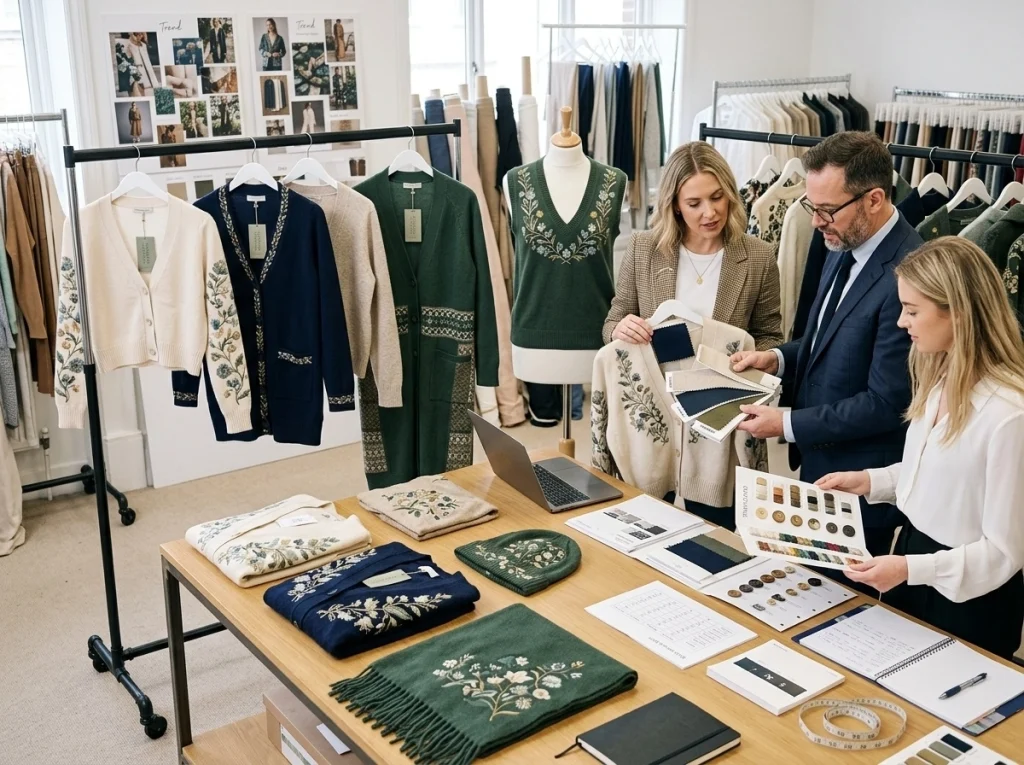
An embroidered cardigan collection becomes commercially stronger when embroidery functions as a collection language rather than a one-off decoration. Buyers usually get more value when the design system can be repeated across several styles, price points, and reorder windows.
Brand recognition is stronger when embroidery becomes a collection language
A single embroidered cardigan may look good, but a collection performs better when the embroidery creates continuity. That continuity can come from a recurring emblem, a tonal logo family, a seasonal icon, a club-style crest, a floral story, or a limited set of placement rules.
When the embroidery language is repeated intelligently, the collection becomes easier for wholesale buyers, merchandisers, and end customers to understand. The garments feel related, even when the silhouettes differ. That is especially useful for brands trying to look more established without overbuilding every individual style. A recognizable embroidery system can do part of the branding work that would otherwise need to come from louder graphics or more aggressive styling.
Embroidery helps create line extensions beyond one cardigan
One of the strongest reasons to develop an embroidered cardigan collection is that the concept can travel. If the visual language works on the cardigan, it may also work in a lighter cardigan custom variation, a matching pullover, or a coordinated custom sweater vest. That gives the buyer more flexibility in assortment building.
From a development point of view, this matters because line extension is where value compounds. You are no longer paying for a single decorated item. You are building a system that can support multiple SKUs with related identity. A motif that starts on a cardigan may extend into sweater development for a companion style, or into custom knit projects if the brand wants matching accessories, gifting pieces, or small capsule extensions.
Value is built at three levels, not one
The most reliable way to judge value is to separate it into three levels: product value, retail value, and reorder value.
| Value lever | What it adds | Factory checkpoint | Main trade-off |
|---|---|---|---|
| Small logo embroidery | Clear brand recognition | Placement accuracy and stitch clarity | Lower visual impact |
| Placement embroidery | Stronger visual identity and premium feel | Distortion control and panel stability | Higher sampling and QC attention |
| Multi-style embroidery story | Better collection cohesion | Artwork consistency across styles | More planning upfront |
| Private label packaging | More retail-ready presentation | Label, hangtag, and packing alignment | Added coordination before bulk |
| Reorder-ready development | Faster repeat business and fewer mistakes | Approved artwork, color references, and PP controls | Less room for late design changes |
Product value is what the garment itself gains. Retail value is how much more complete and brand-ready the item feels once labeling, packaging, and presentation are aligned. Reorder value is what the buyer gains later, when the style can be repeated with fewer errors and less internal confusion. In practice, the third one is often the most important. A collection that cannot be repeated cleanly is harder to scale, no matter how attractive the first sample looks.
How to plan embroidery without creating factory-side problems
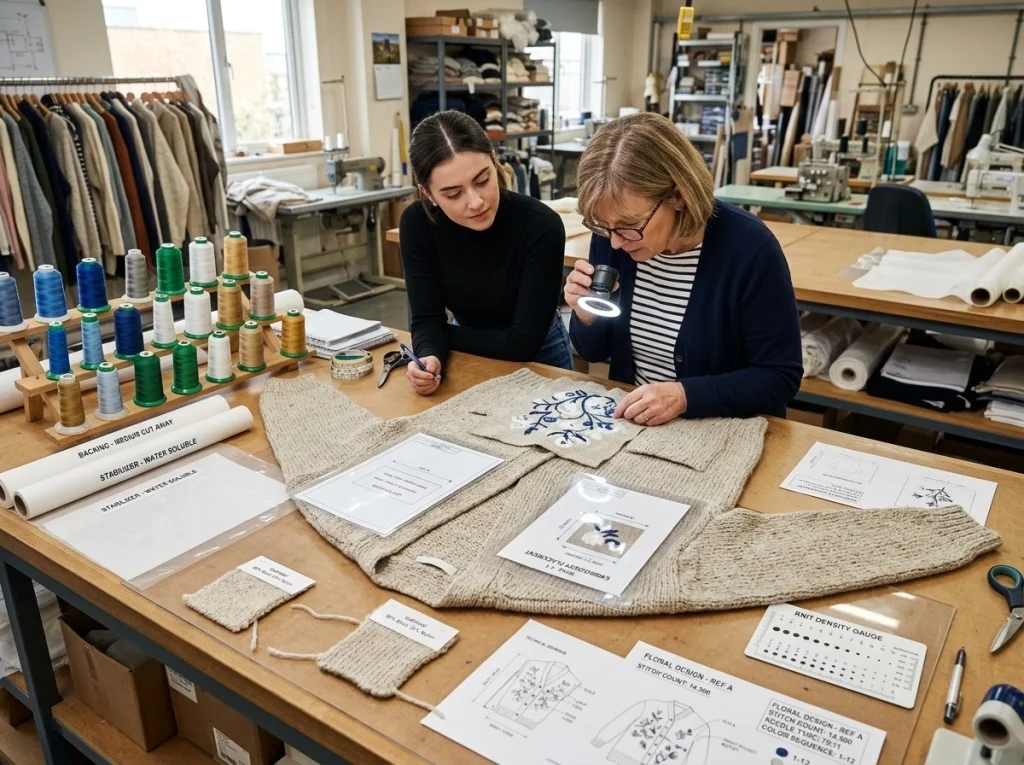
The commercial value of embroidery depends on whether the technical plan is realistic. Buyers usually get the best result when embroidery decisions are made early enough to influence yarn choice, base construction, and sample review. If those decisions are delayed, development becomes slower, quotes become less stable, and avoidable quality issues show up later.
Start with yarn, gauge, and base construction
The first question is not artwork. It is whether the knit base can hold the embroidery well. Smooth and compact yarn surfaces usually give cleaner results than hairy or heavily brushed ones. Mid-gauge constructions are often easier to stabilize than very loose or very delicate ones. Placement near plackets, button lines, or tension-sensitive areas needs extra review.
That is one reason a capable OEM knitwear service should look at embroidery feasibility before artwork is treated as final. If the cardigan body needs a different stitch balance, a firmer backing area, or a placement adjustment, it is better to solve that during development than after the first sample disappoints.
Placement, backing, and stitch density need early decisions
A buyer may see embroidery as a visual element, but the factory has to treat it as a structural one. Placement affects how the panel behaves. Backing affects comfort, appearance, and shape. Stitch density affects how heavy, crisp, or stiff the decorated zone becomes.
This is where many good-looking ideas turn into average bulk results. An embroidery that looks sharp on a single showroom sample may behave differently across sizes, colorways, or yarn batches. If the placement is too close to a placket roll line, pocket opening, rib edge, or button area, the garment may not sit cleanly after finishing. If the density is too aggressive, the surface can lose its natural knit character.
The practical solution is not to avoid embroidery. It is to specify it with production in mind. That means confirming artwork scale, placement distance, thread behavior, backing choice, and likely tension impact before the project moves too far.
Sampling should test more than appearance
Sampling is where embroidery either proves its value or exposes its weakness. The sample should not be judged only by how it looks in a photo. It should also answer whether the embroidery stays balanced after washing, whether the panel remains flat, whether sizing holds, and whether the same result can be repeated in bulk.
For embroidery-led knitwear, sample approval should cover at least four questions. Does the placement look intentional on the actual silhouette? Does the hand-feel still match the target market? Does the garment stay stable through finishing? Can the factory repeat the result across size runs and production lots?
That is also where retail-readiness starts to matter. If the cardigan is intended for private label sale, the embroidered identity should be supported by correct fiber content, country-of-origin disclosure, and responsible business identification under the FTC’s apparel labeling guidance. Care instructions matter too, because the FTC’s care labeling requirements make it clear that garment care claims should be accurate, durable, and supported. In other words, value is not only what the embroidery adds visually. It is also whether the finished product is ready for real retail handling.
Where buyers usually lose money on embroidered cardigan programs
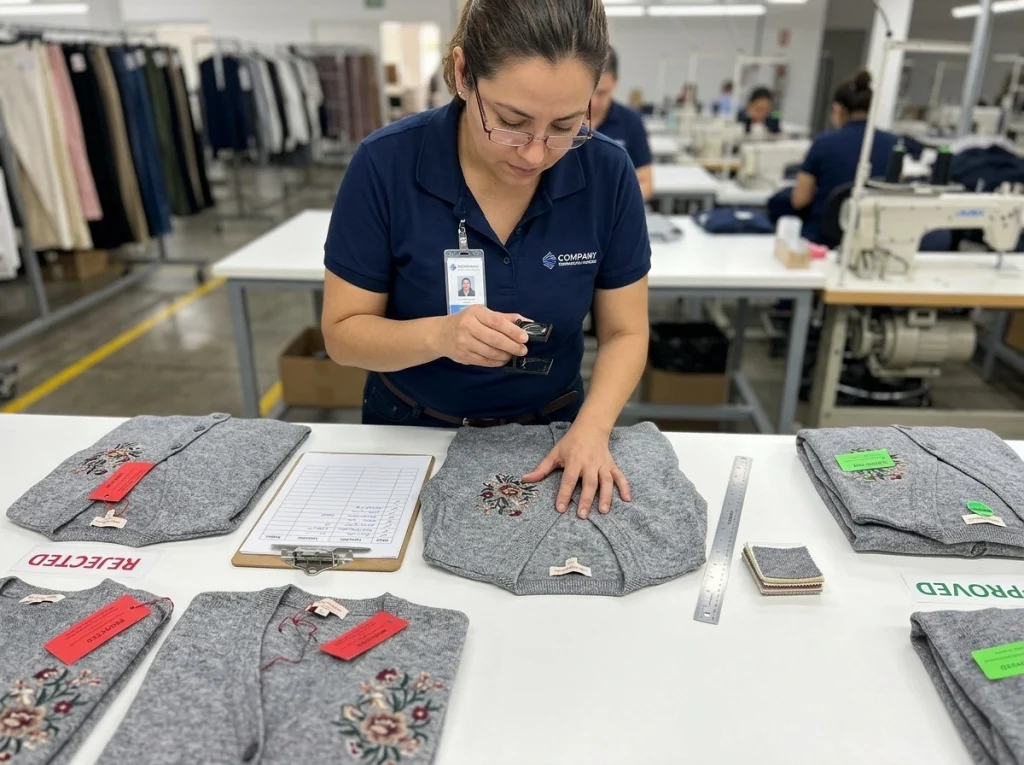
Buyers usually lose money on embroidered cardigan programs when they add complexity faster than they add control. The problem is rarely embroidery itself. The problem is using it without a clear commercial purpose, a stable technical base, or a disciplined approval process.
Over-design at sample stage
The fastest way to weaken margin is to overload the first round. Too many placements, too many thread colors, too many body changes, and too much artwork revision can turn a promising concept into a slow and expensive development cycle.
A better approach is to decide what embroidery is supposed to do. Is it there to signal brand identity, create a premium tier, or support a capsule theme? Once that role is clear, the design can stay focused. A cardigan does not need embroidery on every panel to feel elevated. In many cases, one controlled signature detail does more for the collection than multiple decorative zones fighting each other.
Underestimating MOQ and lead time effects
Embroidery affects timing indirectly as much as directly. It may not always dominate the lead time, but it adds review points. Placement approval, thread confirmation, strike-off review, and panel behavior can all slow decisions if the concept is still moving.
That is why buyers should treat MOQ and lead time as planning questions, not just quotation questions. On many programs, quantity depends not only on the base cardigan but also on yarn sourcing, stitch complexity, embroidery execution, and how many variations the buyer is trying to launch at once. A stable body with controlled variations is easier to quote than several different silhouettes carrying unrelated embroidery stories.
The same logic applies to replenishment. If the collection is likely to repeat, it is worth locking approved artwork files, thread references, and placement rules early. Reorders are usually smoother when the first round is documented with discipline rather than speed.
Treating embroidery as decoration instead of a QC item
A common mistake is to inspect embroidery only for aesthetics. In production, embroidery is also a quality control issue. It needs alignment, consistency, clean execution, and compatibility with the knit structure. If QC only checks the garment body while treating embroidery as a secondary embellishment, bulk variation becomes more likely.
From a factory perspective, embroidery should be checked with the same seriousness as measurements, button security, placket balance, and overall finishing. That includes looking for skewed placement, uneven thread coverage, tension marks, backing discomfort, and bulk inconsistency between colors or sizes. On a good private label sweaters program, embroidery is not the final decorative afterthought. It is one of the approved production standards.
How to build a collection that is easier to quote, sample, and reorder
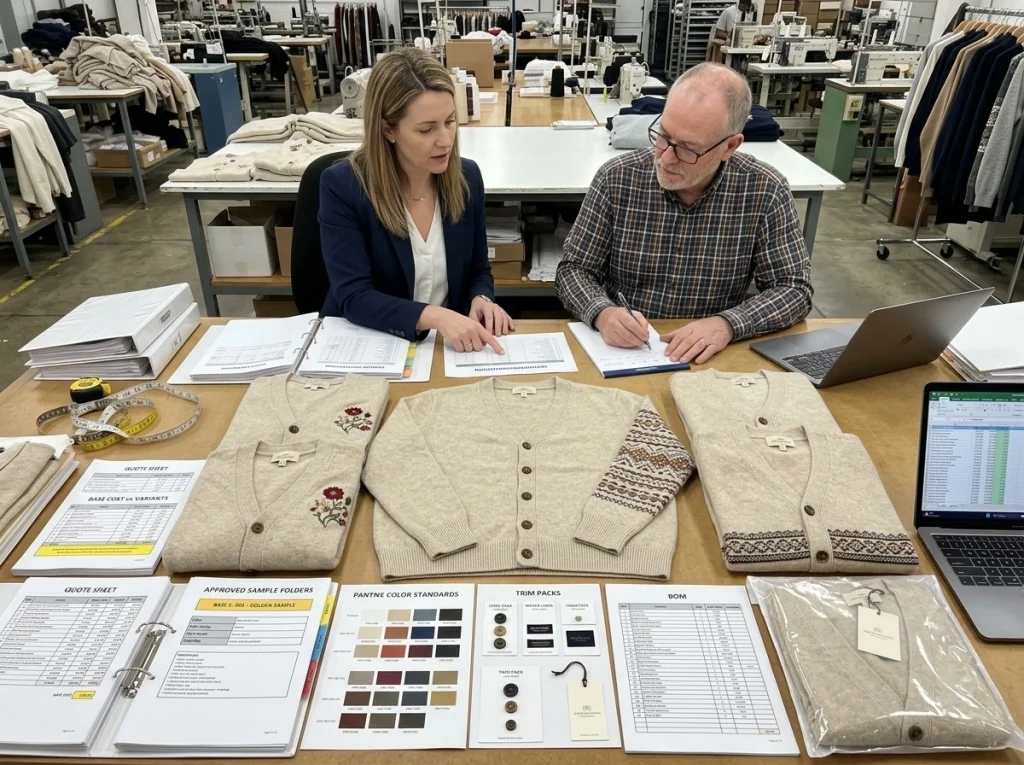
The easiest embroidered cardigan collections to manage are usually not the most complicated ones. They are the ones with a stable base, a clear embroidery logic, and a development package that reduces interpretation risk from the first quote to the final shipment.
Build around one stable base body first
For most buyers, the smartest starting point is one well-developed cardigan block. That gives the factory a fixed silhouette, established fit, and predictable construction behavior. Once that base is stable, embroidery can create variety without forcing a full restart every time.
This approach has a commercial advantage as well. One body can support several levels of offer: a plain version, a tonal embroidery version, and a stronger statement version. Instead of building four unrelated cardigans, the buyer builds one reliable base and lets embroidery create the collection ladder.
Use a smart collection structure
A commercially sound structure often works better than a highly creative but fragmented one. In practice, a balanced launch may include one hero style for branding, two more commercial styles for broader sales, and one lower-risk replenishment option for repeat business.
This is also where the secondary keyword opportunity makes business sense. A cardigan collection can extend into a coordinated custom sweater vest or pullover without losing the embroidery language. That gives buyers more assortment depth while keeping development more efficient than starting from unrelated concepts. If the collection strategy is strong, embroidery becomes a bridge between styles rather than a cost layer attached to only one SKU.
Align development documents before production
The handoff package matters more than many buyers expect. If the artwork file, placement spec, stitch color references, sizing notes, trim details, and packaging instructions are unclear, the factory has to interpret too much. That usually increases sampling rounds, weakens quote accuracy, and creates more room for mismatch in bulk.
Documentation is also where brand value becomes tangible. If the garment is meant to feel premium, the embroidery should align with brand labels, care labels, hangtags, and packing standards. A collection becomes more retail-ready when decoration, fit, labeling, and packaging are treated as one system. That is especially important for buyers who want an embroidered cardigan to feel like part of a complete program rather than an isolated embellished item.
When a custom embroidered cardigan collection is the right move

A custom embroidered cardigan collection is the right move when the buyer needs stronger identity, better assortment separation, and a more complete retail story than a plain knit program can provide. It is usually less suitable when the only priority is the lowest possible cost or the fastest possible turnover.
Embroidery makes the most sense for brands that are trying to look more distinctive without moving into overly complex knit engineering. It is particularly useful for boutique labels, seasonal capsules, gifting programs, club or campus stories, resort lines, and selected wholesale assortments where subtle visual difference matters. In those situations, embroidery can help the collection feel branded without becoming too niche.
It is less effective when the product needs to be extremely cost-driven or highly speed-oriented. If the goal is pure volume, low development friction, or the fastest possible replenishment, a cleaner knit solution may be better. In some cases, jacquard or intarsia may serve the design more efficiently than embroidery, especially when the visual story needs to be built directly into the knit structure. The best choice depends on what kind of value the buyer is actually trying to add.
Conclusion
A custom embroidered cardigan collection adds value when it improves brand identity, price architecture, and retail readiness without making development unstable. The embroidery itself is not the strategy. The strategy is using embroidery to create a stronger collection with clearer commercial logic.
From a factory perspective, the safest path is to lock the base cardigan first, define the embroidery role clearly, and test the concept through real sample controls rather than relying on visuals alone. That means reviewing yarn surface, gauge, placement, backing, hand-feel, care requirements, labeling, and bulk repeatability before launch decisions are made.
If you are evaluating whether your concept should start as a small pilot or a broader seasonal line, it helps to work with a custom knitwear manufacturer that can review construction, sampling, private label details, and reorder planning together instead of treating embroidery as a separate afterthought.
FAQ
Is a custom embroidered cardigan better for small collections or larger programs?
It can work for both, but it usually creates more value when it is planned as part of a collection. In a small capsule, embroidery can give the line a stronger point of view. In a larger program, it becomes even more useful because the same visual language can support several price points and style extensions.
Does embroidery significantly increase cardigan lead time?
Sometimes, but usually the bigger issue is decision timing rather than machine time alone. If artwork, placement, and approvals are clear early, embroidery can be managed efficiently. When those details change late, development slows down and bulk planning becomes less predictable.
What is the biggest QC risk in embroidered knitwear?
The biggest risk is instability between decoration and knit structure. That can show up as puckering, distorted panels, poor placement balance, uncomfortable backing, or inconsistent bulk appearance. Good QC should treat embroidery as part of garment performance, not just surface decoration.
Can a cardigan custom program extend into a custom sweater vest line?
Yes, and that is often a smart commercial move. If the embroidery concept is strong and the brand language is clear, the same motif or placement system can move into a custom sweater vest, pullover, or accessory extension. That usually creates more value than keeping embroidery limited to one isolated cardigan style.
What should buyers confirm before approving the PP sample?
The short answer is everything that affects repeatability. Buyers should confirm artwork scale, placement, stitch clarity, panel stability, hand-feel, trim balance, labeling, care instructions, and whether the approved look can be repeated across sizes and colors without changing the product character.