 CN Sweaters
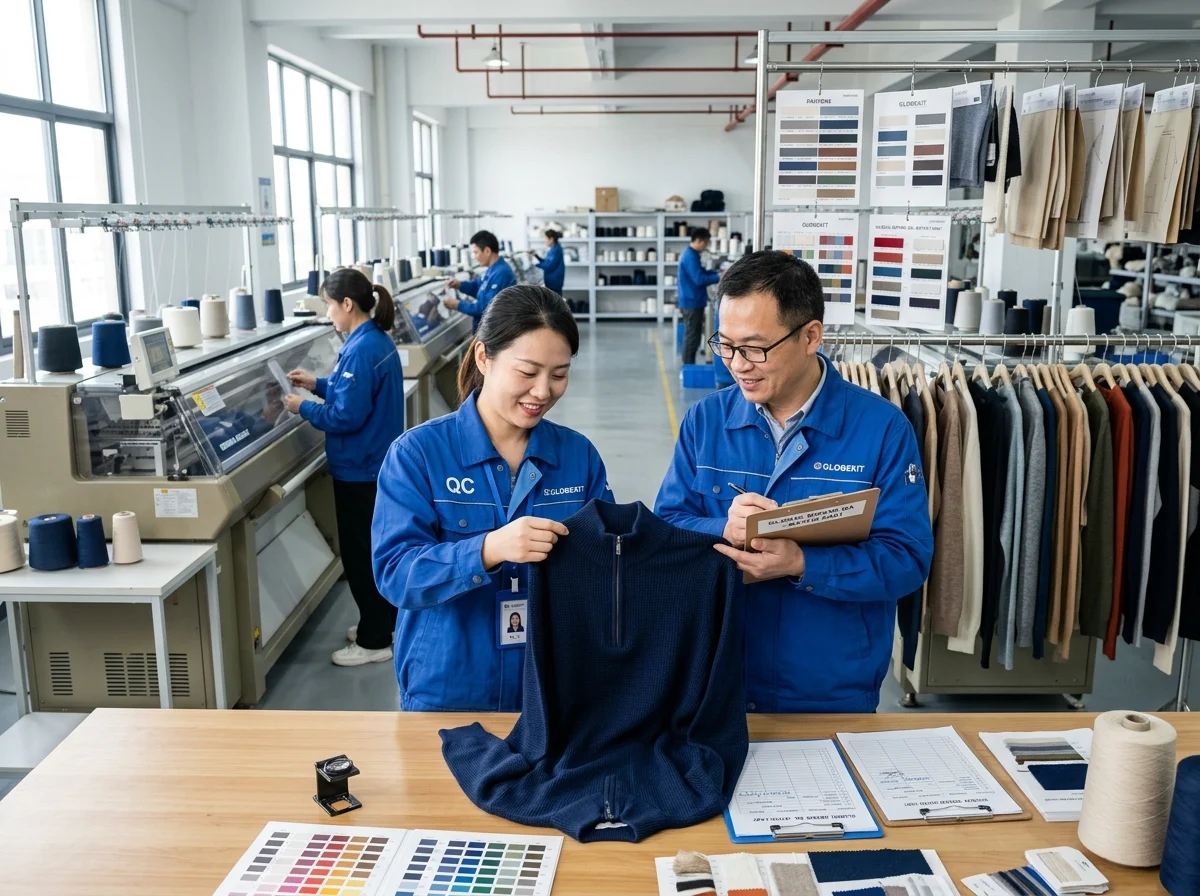
A premium mens zip neck jumper requires a precise synergy between hardware stability and textile elasticity to prevent high return rates. This comprehensive guide enables brand managers and procurement specialists to identify and eliminate manufacturing defects before bulk production commences.
Selecting the Wrong Material for a Mens Zip Neck Jumper
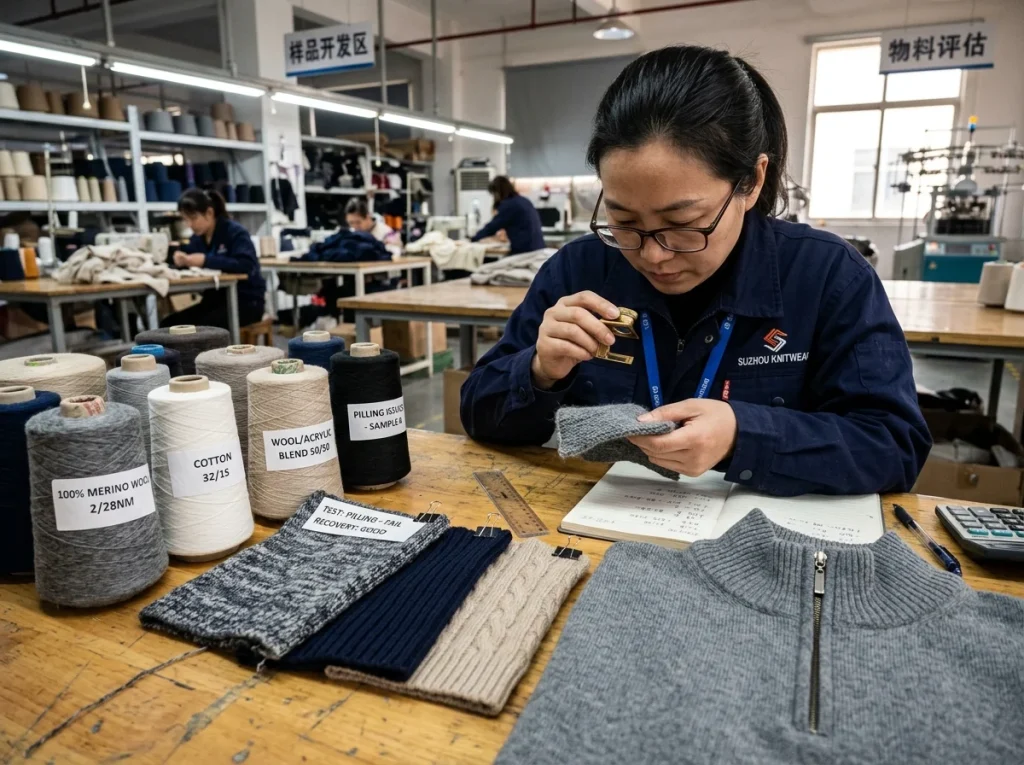
Material selection is the single most significant factor in a garment’s durability and consumer perception, yet brands often overlook the long-term structural implications of fiber choice. For a mens zip neck jumper, the material must withstand the mechanical stress of a zipper without warping or pilling, a balance that many lower-tier manufacturers fail to strike.
The Pilling Problem in Synthetic Blends
Pilling occurs when friction causes fiber ends to migrate to the surface, forming unsightly bobbles. In cheap acrylic or polyester blends, these pills are “tenacious,” meaning the synthetic strength prevents them from breaking off naturally. When designing a high-end half zip sweater men expect to wear frequently, sourcing long-staple fibers like 17.5-micron Merino wool or Supima cotton is non-negotiable. These fibers have fewer ends to fray, ensuring the garment looks new even after thirty washes. Furthermore, the twist of the yarn plays a vital role; a “high-twist” yarn creates a tighter surface that resists the abrasion caused by the zipper slider moving up and down the placket.
Breathability and Moisture Management
The functional appeal of a zip neck is its ability to regulate temperature. If the base fabric is a high-percentage synthetic with poor thermal conductivity, the zipper becomes purely decorative. In many sourcing scenarios, brands prioritize “softness” at the showroom level, which is often achieved through heavy chemical softeners on low-grade wool. This compromises the fiber’s natural ability to wick moisture. A technical approach involves utilizing “active” fibers that complement the physical ventilation of the open collar. Cotton-silk or merino-tencel blends are increasingly popular for “trans-seasonal” jumpers because they maintain a dry micro-climate against the skin.
Fiber Recovery and Elasticity Failures
A common mistake is neglecting “recovery”—the fabric’s ability to return to its original shape after being stretched. Since the neck of a zip neck jumper is frequently manipulated, the ribbing must contain high-quality elastane or be knitted with a high-tension “full-needle” stitch. Without this, the collar will eventually “smile” or sag, a defect that is impossible to fix once the garment has left the factory floor.
Technical Failures in Zipper Selection and Installation
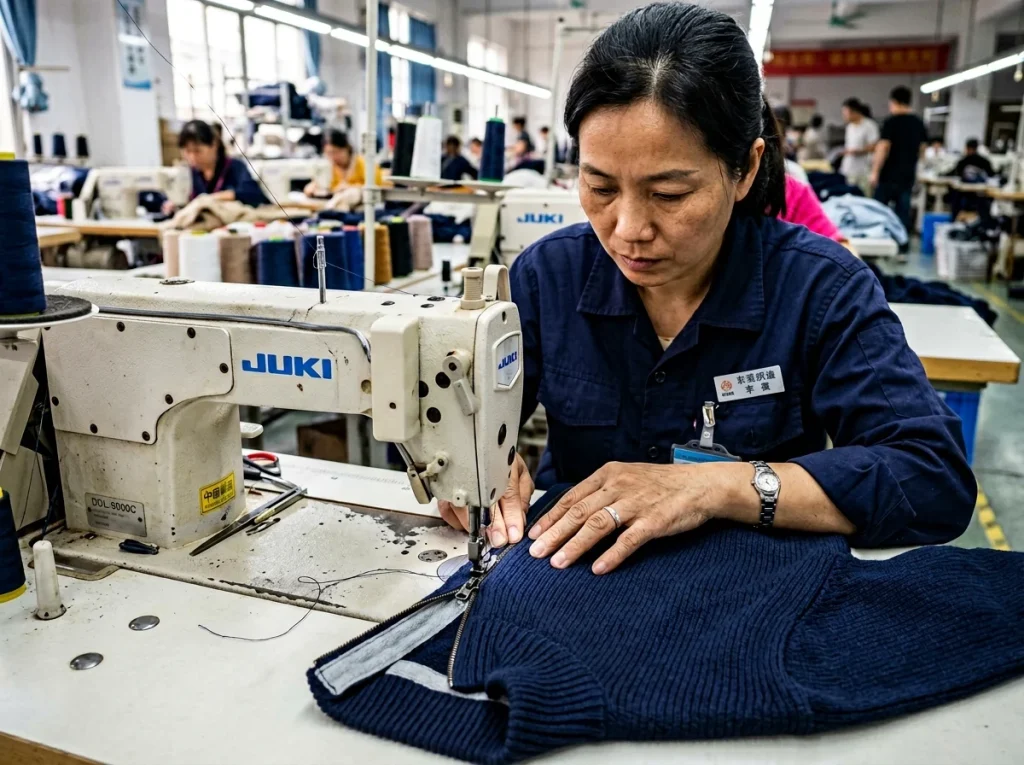
The zipper is the mechanical heart of the garment, yet it is where most “hidden” cost-cutting occurs. A failure in the zipper mechanism or its integration into the knit fabric is the leading cause of consumer returns in the mid-to-high luxury segment.
Zipper Gauge and Weight Discrepancies
Mismatching the weight of the zipper tape to the weight of the knit creates “zipper waves.” For a 12GG mens zip neck jumper, a Size 5 metal zipper is often too heavy, causing the front of the sweater to buckle when the wearer sits down. Conversely, a Size 3 nylon coil zipper might feel “flimsy” on a chunky 7GG knit. The industry benchmark for reliability is YKK, specifically their Excella or Vislon ranges, which feature self-lubricating teeth that prevent the “catch” often found in generic alternatives. Sourcing teams must specify the exact zipper tape material—typically polyester—and ensure it is pre-shrunk to match the knit’s shrinkage profile.
Internal Guard and Placket Construction
A frequent design oversight is the omission of a “zipper garage” or an internal guard. Without a fabric flap behind the zipper, the cold metal or sharp teeth will irritate the wearer’s neck. Furthermore, for a professional half zip sweater men can wear over a dress shirt, the zipper tape must be concealed. This requires a “double-layered” placket construction where the zipper is sandwiched between two layers of knit. This not only looks cleaner but adds the structural rigidity necessary to keep the collar standing upright when unzipped.
The Ripple Effect: Stabilization Failures
Because knitwear is flexible and zipper tape is rigid, sewing them together is a high-risk operation. If the factory does not use “fusible stay tape” or a stabilized interlining on the placket edges, the machine’s feed dogs will stretch the knit while sewing. The result is a “wavy” zipper that never lays flat. High-end manufacturing requires the zipper to be “basted” (temporarily hand-stitched) before the final machine pass to ensure zero-tension alignment.
Inaccurate Sizing Standards for Western Markets
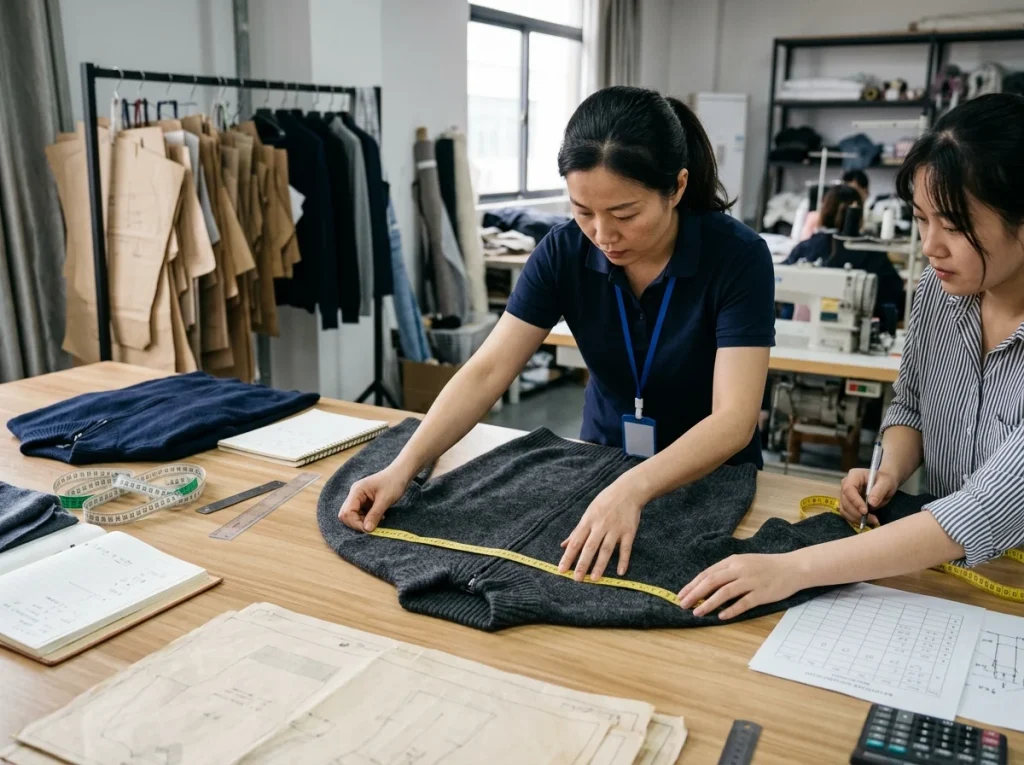
Sizing is the most frequent point of friction between Asian manufacturers and Western brands. A “Medium” in a domestic Chinese factory is fundamentally different from a “Medium” at a US-based retailer like Nordstrom or a UK-based brand like Reiss.
Neck Circumference and Collar Stand
The “zip neck” functionality relies on the collar being comfortable when fully closed. Many designers fail to account for the “layering gap.” If a zip neck jumper is designed with a 38cm neck circumference for an International Medium, it may be too tight for a Western customer who typically measures 40-41cm in that size. Additionally, the “Collar Stand”—the height of the neck—must be graded carefully. A collar that is too tall (over 8cm) will hit the jawline uncomfortably, while one that is too short (under 6cm) lacks the “preppy” aesthetic that drives sales in this category.
Armhole Depth and Shoulder Slope
Western physiques generally require a deeper armhole and a broader shoulder slope than East Asian patterns provide. If the armhole is too “high,” it bunches up against the wearer’s armpit, especially when worn over a shirt. A “semi-set-in” sleeve is the preferred construction for a modern mens zip neck jumper, as it provides a tailored look while allowing for the natural movement of the shoulder. Ignoring these “Grade Rules” leads to a garment that feels “small” even if the chest measurement is technically correct.
Miscalculating Knit Gauge and Stitch Density
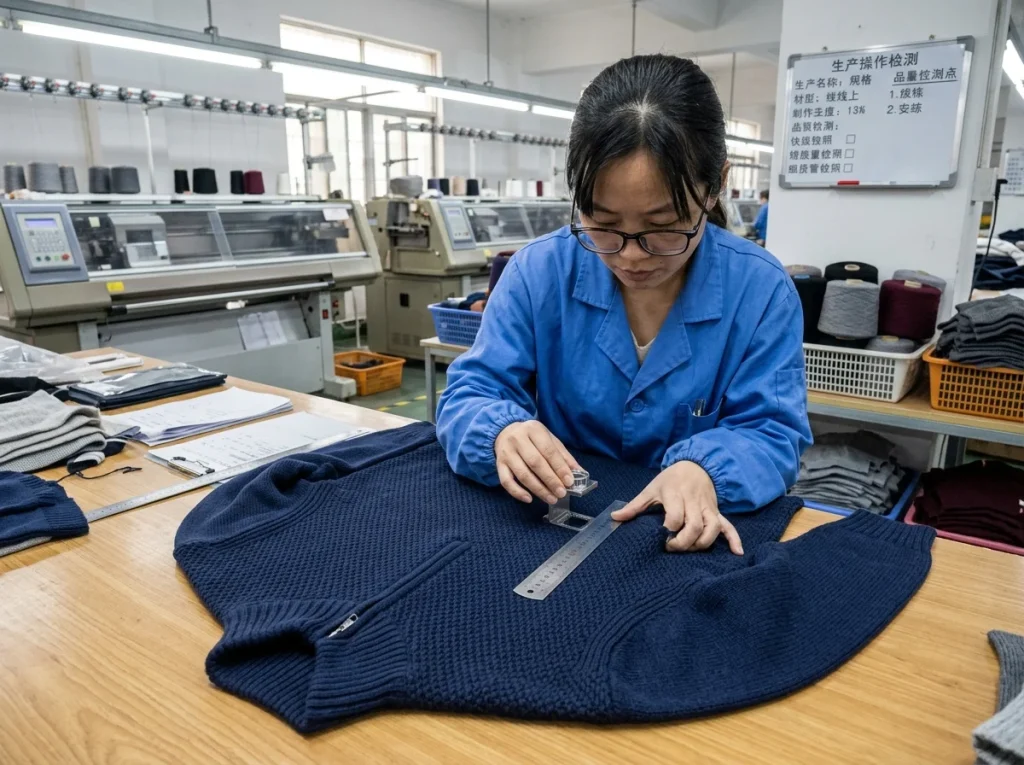
Gauge (GG) is often misunderstood as a measure of quality, when it is actually a measure of “finesse” and application. Choosing 7GG when the market demands 12GG—or vice versa—can lead to dead stock.
The 12GG vs. 14GG Business Logic
A 12GG half zip sweater men wear to the office is the “gold standard.” It is thin enough to fit under a blazer but substantial enough to provide warmth. However, moving to 14GG increases production time by nearly 20% due to the higher stitch count. Brands often make the mistake of requesting a “12GG look” but using a “10GG yarn,” which results in a “loose” knit that snags easily. Stitch density—measured by the weight of the garment—is the true indicator of value. A 12GG jumper weighing 320g is significantly more durable than one weighing 260g made from the same fiber.
Snagging and Surface Integrity
On lower-gauge knits (like 5GG or 7GG), the loops are larger and more prone to catching on jewelry or sharp edges. If the “Tension” (the tightness of the stitch) is too loose to save on yarn costs, the garment will lose its shape after one dry cleaning cycle. Technical sourcing managers must request a “swatch test” for tension to ensure the knit meets a minimum “bursting strength” standard before committing to bulk production.
Knit Gauge and Tension Errors: Balancing Weight and Breathability
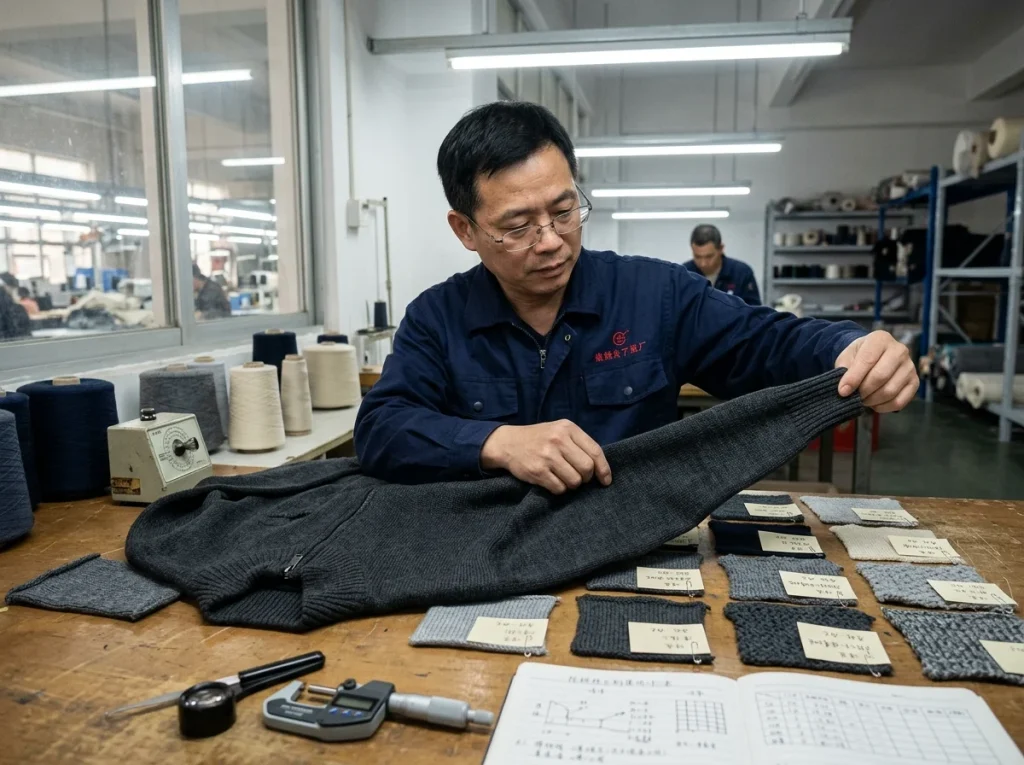
Achieving the perfect “hand-feel” requires a delicate balance between yarn weight and machine gauge. A common error is “over-knitting,” where too much yarn is forced into a tight gauge, resulting in a garment that feels “boardy” or stiff. Conversely, “under-knitting” leads to a flimsy product that becomes transparent when stretched.
The Mathematics of Yarn Ply
For a mens zip neck jumper, 2-ply yarns are preferred over single-ply. A 2-ply yarn is two strands twisted together, which balances the internal torque of the fiber and prevents the garment from “twisting” (where the side seams migrate to the front). In a 12GG machine, a 2/30nm (count) yarn is the industry standard. If a factory suggests a 1/15nm yarn to save cost, the resulting jumper will likely lean or skew after the first wash because the yarn’s natural twist hasn’t been neutralized by plying.
Managing Tension for Seasonal Versatility
Spring collections require a “looser” tension for airflow, but this must be compensated for by using “high-twist” yarns to maintain structural integrity. Many brands fail to communicate these “Tension Settings” to the factory, resulting in winter-weight jumpers being delivered for spring launches. A technical specification sheet should always include a “10cm x 10cm stitch count” (wales and courses) to ensure consistency across different production batches.
The Placket and Collar Structural Integrity: Preventing Roll and Sag
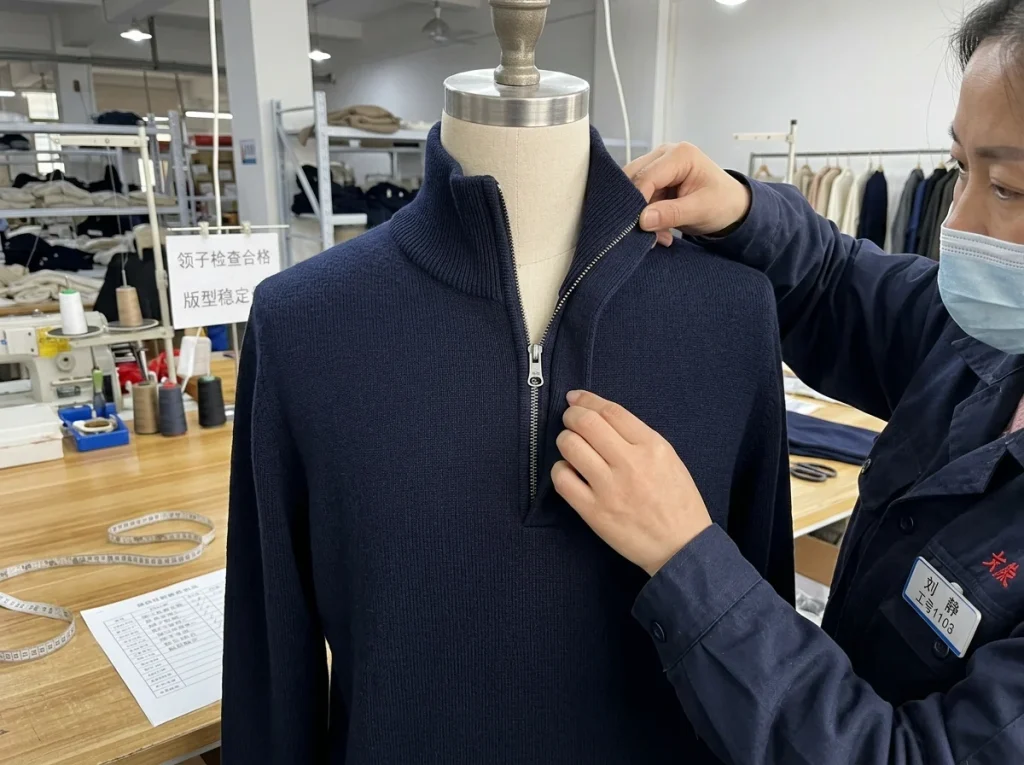
The collar of a zip-neck is its most defining feature. If it collapses or rolls inward, the entire aesthetic is ruined. This is a structural engineering problem as much as a fashion design problem.
Interfacing and Support Structures
To keep a collar standing at a sharp 90-degree angle, the internal construction must be reinforced. High-end manufacturers use a “Milano Stitch” for the collar, which is a specialized knit structure that is naturally more rigid than standard ribbing. Additionally, a “crochet chain” or “twill tape” should be sewn into the back neck seam. This prevents the weight of the collar and zipper from stretching the shoulder line, a common defect known as “shoulder drop” in older or poorly made garments.
The “Smile” Defect in Half-Zips
When a half zip sweater men is unzipped, the two sides of the collar should fall symmetrically. If the tension on the left side of the zipper differs from the right by even a few millimeters, the collar will “smile” (one side sits higher than the other). This is often caused by manual sewing errors. Automated zipper-attachment machines are the solution, but they are expensive, so brands must verify if their manufacturer uses automated or manual attachment processes.
Zipper Tape vs. Knit Fabric: Solving the Differential Shrinkage Puzzle
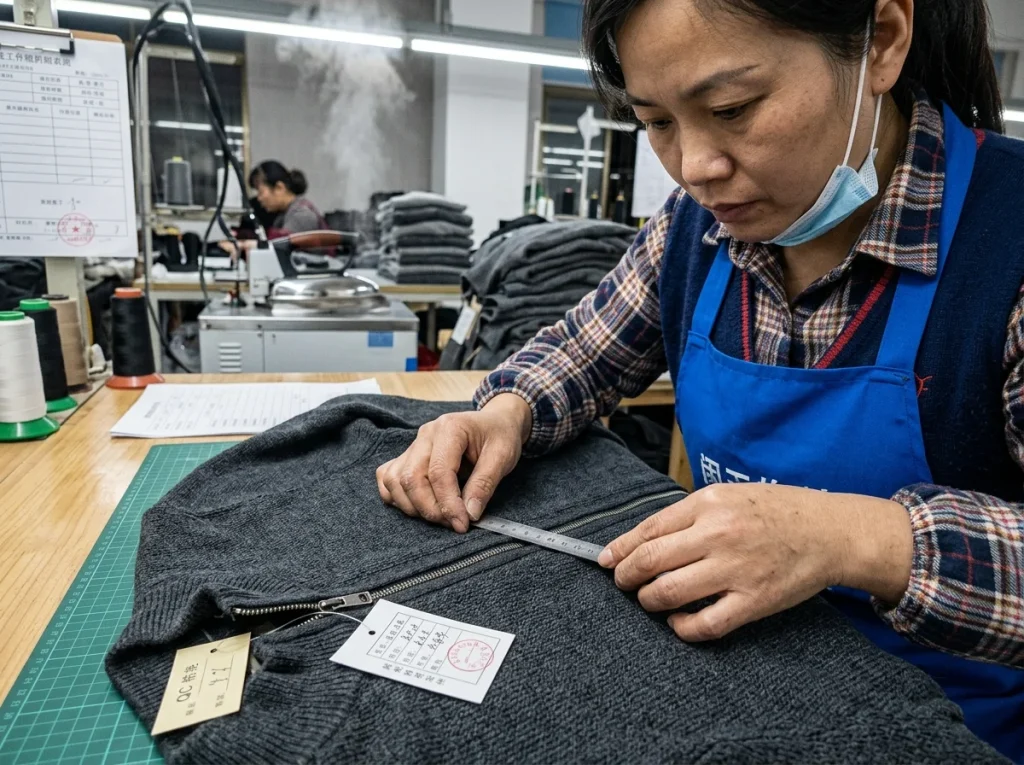
One of the most devastating mistakes in knitwear production is failing to account for “differential shrinkage.” Knit fabric (especially wool or cotton) and zipper tape (usually polyester) shrink at different rates when exposed to heat or steam during the “final pressing” stage.
Pre-shrinking Protocols
A professional factory will “tumble dry” or “steam relax” the knitted panels before the zipper is attached. If the zipper is sewn onto “live” (unrelaxed) fabric, the first time the consumer dry-cleans the zip neck jumper, the fabric will shrink by 3-5% while the polyester zipper tape stays the same length. This results in a permanent “bowing” of the front placket. Technical QC must involve a “wash test” of the prototype to calculate these exact percentages.
Tape Material Compatibility
While polyester tape is standard, cotton-blend zipper tapes are available for 100% natural fiber garments. These are more expensive but offer a much more harmonious shrinkage profile. For luxury brands, the extra $0.50 per garment is a worthy investment to avoid the “buckling” effect that characterizes low-quality knitwear.
Western Market Sizing Discrepancies: Grade Rules and Tolerance Issues
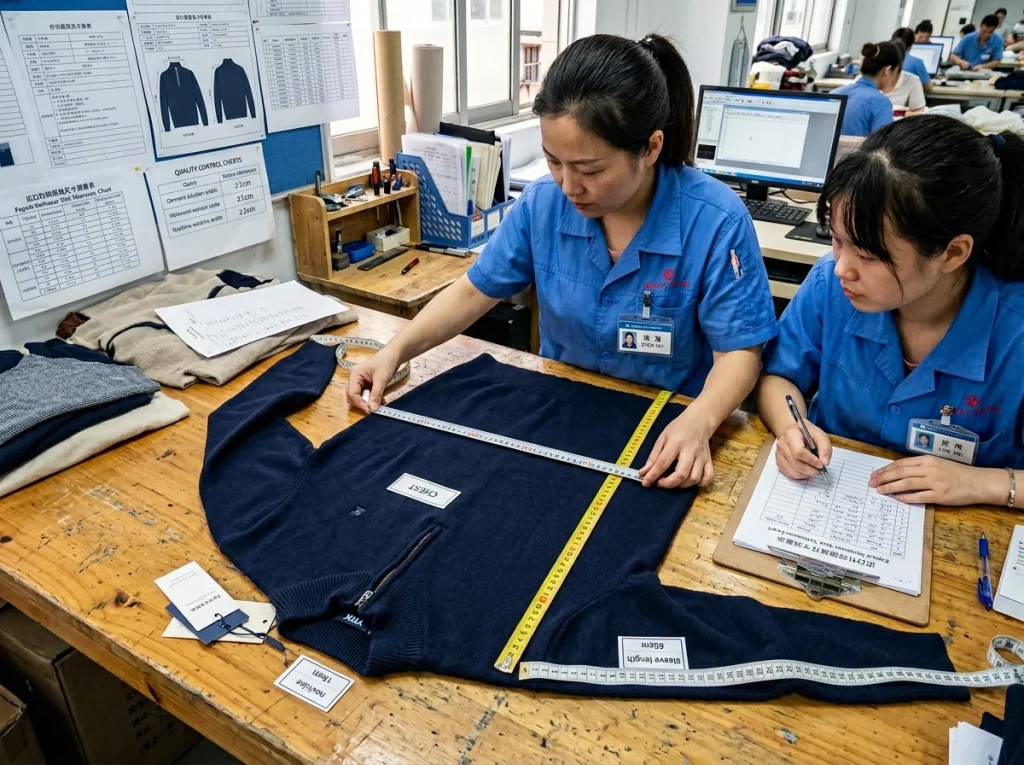
The transition from a “Size Large” in a designer’s head to a “Size Large” on a retail shelf in London or New York is fraught with peril. Sizing “Tolerance”—the allowable margin of error—is where many B2B partnerships fail.
The “Body Length” Trap
Western consumers generally have longer torsos than East Asian populations. A common mistake is using a “standard” body length that ends up being a “crop top” on a 6-foot tall European male. Grading for the Western market requires an incremental increase in length that is non-linear—meaning the “jump” from Medium to Large is often greater than the jump from Small to Medium. Failure to follow these specific “Grade Rules” results in high return rates for “short fit.”
Tolerance and Quality Control
In mass production, a +/- 1.5cm tolerance is often standard. However, for a mens zip neck jumper, a 1.5cm error in the neck circumference can make the garment unwearable when zipped. Sourcing managers must negotiate “Tight Tolerances” for critical points of measure (POM), such as the neck width and the zipper length, even if the sleeve length tolerance remains standard.
Neglecting the QC Protocol: Sourcing Errors in Bulk Production
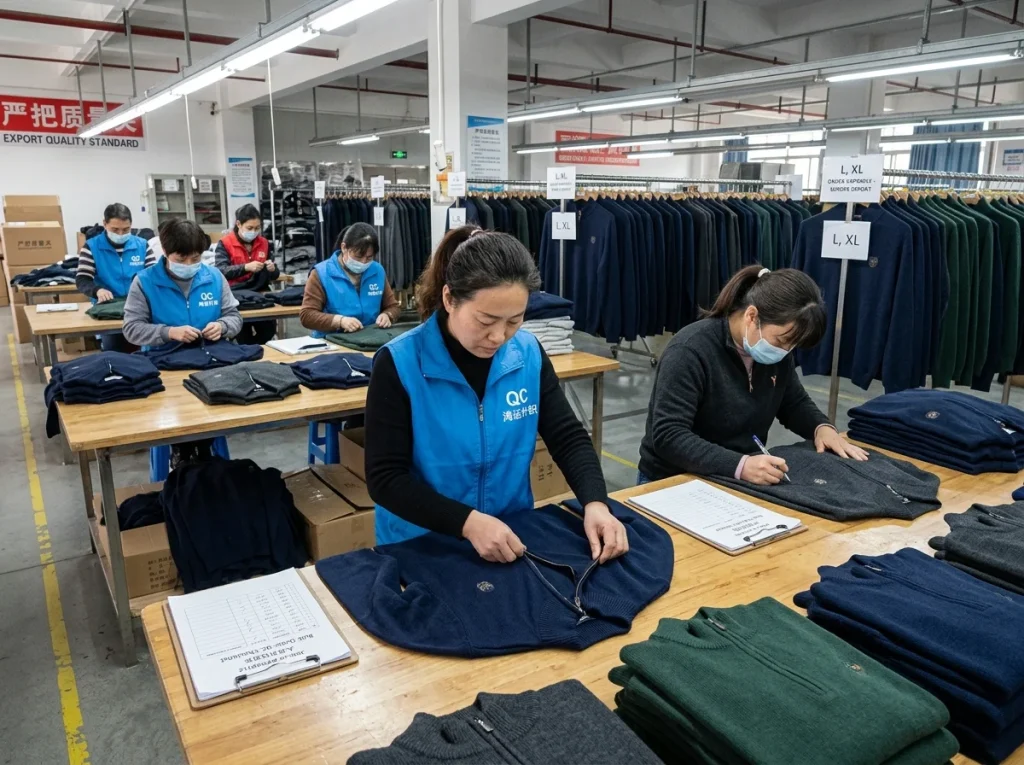
The final mistake is assuming that the “Gold Sample” (the perfect prototype) will be identical to the 5,000 units in the shipping container. Quality drift is a reality in high-volume manufacturing.
In-Line vs. Final Inspection
Waiting until the garments are bagged and boxed to perform QC is a recipe for disaster. Effective zip neck jumper production requires “In-Line Inspection,” where the zipper attachment is checked before the side seams are closed. This allows for corrections without destroying the garment. Critical checks include “zipper pull strength,” “color-fastness of the tape,” and “symmetry of the collar points.”
The Importance of Metal Detection
For any garment with a zipper, metal detection is a safety requirement for Western markets (especially the EU). Broken needle fragments or stray metal shavings from the zipper manufacturing process can lead to massive lawsuits and total product recalls. A reputable factory must have a conveyor-belt metal detector as a mandatory final step before packing.
Conclusion
Successfully bringing a mens zip neck jumper to market is a complex technical exercise that rewards precision and punishes shortcuts. We have explored how material choice, zipper engineering, and Western-specific sizing are the three pillars of a successful product. By focusing on high-recovery fibers, stabilized zipper plackets, and rigorous in-line QC, brands can move beyond the “disposable fashion” cycle and create garments that build lasting equity with consumers.
The most important takeaway for any sourcing manager is that the “hidden” technical details—the interfacing, the pre-shrinking, and the stitch tension—are what determine the product’s profitability. At CNSweaters, we specialize in bridging the gap between design vision and manufacturing reality. Whether you are scaling an existing line or launching a new collection, contact our technical design team today to ensure your next production run is free from these common, costly mistakes.
Frequently Asked Questions
How can I tell if a factory is capable of high-quality zipper installation?
Ask for a “limit sample” showing their worst acceptable zipper ripple. If they cannot show you a perfectly flat placket on a 12GG knit, they likely lack the stabilization equipment (like fusible tape machines) necessary for premium production.
Is 100% Cotton or a Cotton-Acrylic blend better for bulk wholesale?
100% Cotton is preferred for “premium” positioning due to breathability. However, a 60/40 Cotton-Acrylic blend is more “stable” and resistant to wrinkling, making it a popular choice for high-volume corporate wear or mid-market retail.
Why do collars on half-zips often lose their shape after one season?
This is usually due to a lack of “internal bracing.” High-quality collars use a Milano or half-milano stitch which is denser than the body. If the collar uses the same stitch as the body, it will inevitably sag under the weight of the zipper.
What is the standard lead time for a custom zip neck jumper?
Typical lead times are 45-60 days for bulk production. This includes yarn dyeing (21 days), knitting and linking (15 days), and finishing/QC (10 days). Custom hardware like branded zipper pullers can add 14 days to the timeline.
How do I prevent “Zipper Bite” (fabric getting caught in the teeth)?
This is solved by maintaining a 2mm “clearance zone” between the edge of the knit and the zipper teeth. During production, the placket must be sewn with a specialized “zipper foot” that ensures this consistent distance.