 CN Sweaters
A low minimum is workable only when the buyer and supplier define what the number covers. For low MOQ wholesale knitwear suppliers, the controlling input may be yarn, colour, machine setup, size allocation, decoration or packing rather than a single garment total. The useful decision is whether the proposed assortment can be produced and repeated on documented terms.
This guide is for buyers planning a small first order or a more frequent replenishment cycle. It explains how to compare minimums, separate fixed and variable costs, choose stock or custom-colour yarn, approve samples and release a short run. It does not provide a universal MOQ, price or lead time. Those values must be confirmed for the actual style, yarn, colour split, size range and delivery date.
What Low MOQ Actually Means in Knitwear Production
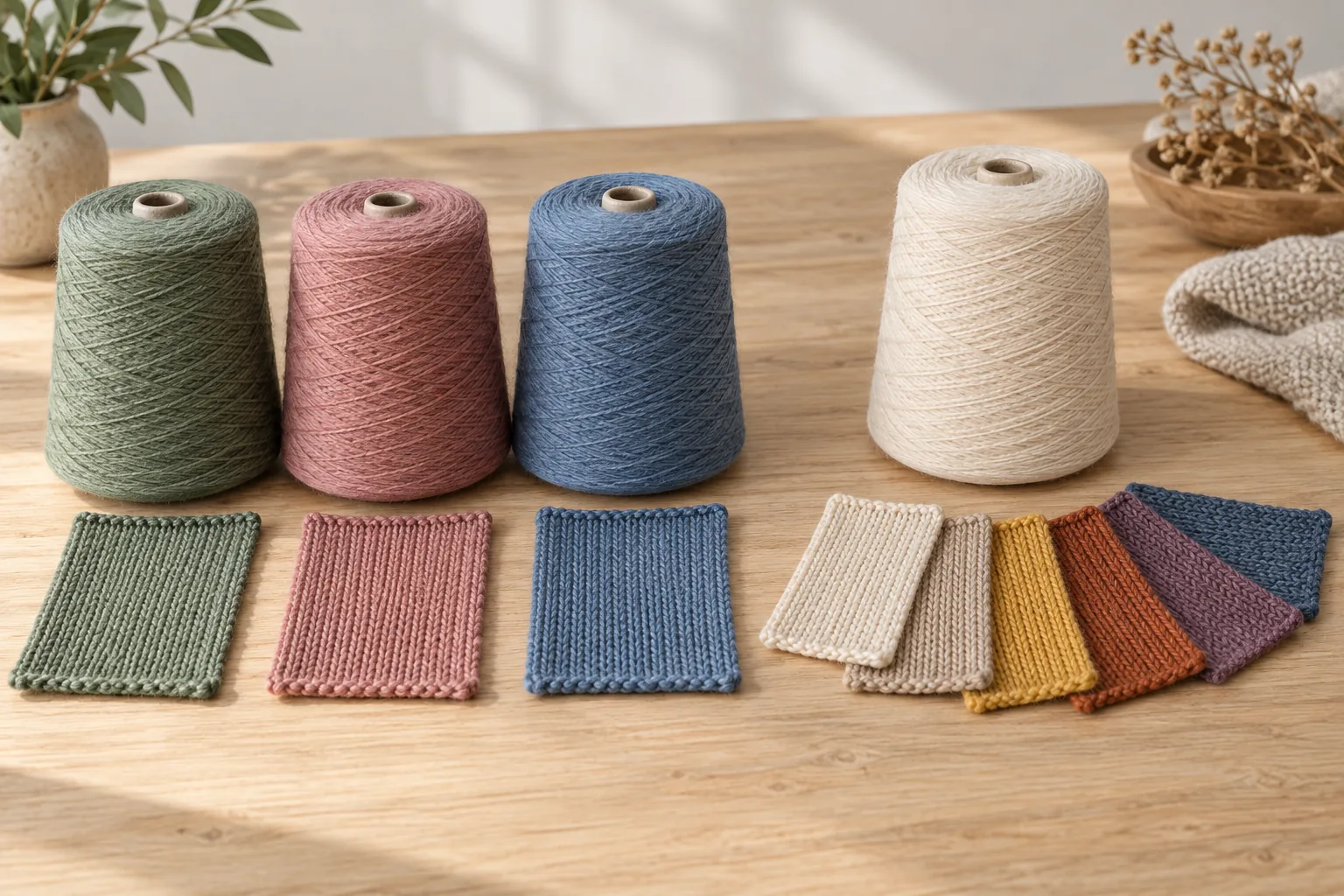
A knitwear minimum begins with the proposed yarn and construction. Fully fashioned panels are programmed and knitted for the style, then linked and finished. A colour that needs a dedicated yarn lot can set a different minimum from an available colour. The supplier should show which input creates the constraint and whether unused material remains part of the buyer commitment.
Why knitwear MOQs differ from cut-and-sew apparel
Do not transfer a minimum from another apparel category without checking the production route. In knitwear, yarn availability, the knitting program, panel balance, linking and wet finishing can each create setup work. Ask the supplier to identify the first irreversible commitment and the evidence needed before it begins. The yarn and garment MOQ guide helps separate those layers.
Separate style-level work from piece-level work. Programming, a knit-down, sample interpretation and line setup can occur even in a short run, while yarn consumption, labels and packing usually change with quantity. Request the scope and cost basis for each line rather than assuming every charge should fall at the same rate.
The realistic MOQ range from a sweater factory perspective
There is no responsible universal minimum for custom knitwear. Ask for the minimum by style, colour, yarn article, size split and trim. Then ask whether the quoted number is a production constraint, a commercial policy or a material purchase requirement. The custom sweater MOQ guide provides a practical comparison format.
A supplier may offer a lower garment quantity by using an available yarn, combining compatible styles, charging for unused material or limiting colour choices. Each route changes the commercial risk. Record the proposed exception in the quotation and sample record so it is not mistaken for a permanent capability or a future reorder promise.
Which constraint sets the workable minimum
Minimums usually reflect several constraints acting together. Yarn must cover the planned colour and waste allowance. Programming and setup must be assigned to the style. Linking, washing, inspection and packing need a workable production sequence. Ask which constraint is active for this order and what design change would alter it.
Treat the supplier answer as an order-specific proposal. Keep the selected yarn, colour split, size allocation, construction and packing scope beside the minimum. If one input changes, request a new confirmation rather than carrying the old number forward. The low-volume cost explanation shows which assumptions to reopen.
How Does Cost Change in a Low MOQ Order?
A short run can have a higher unit cost because style-level work is spread across fewer garments and a material purchase may exceed consumption. The buyer should compare the total committed cost, unused-material ownership, development scope and repeat-order conditions. A lower piece price is not cheaper if key work is excluded or material remains unaccounted for.
Yarn minimums and dye-lot economics
Ask for the yarn article, composition, count, colour route, purchase unit and expected consumption basis. If the colour is made for the order, request the material minimum, usable balance, storage responsibility and disposition rule. Do not infer yarn weight or a mill minimum from another style. The yarn and reorder planning guide helps document the commitment.
An available yarn can reduce the material commitment, but availability must be verified for the required quantity and date. Ask whether it is physically held, supplier-supported or only shown on an old colour card. Record lot identity and the consequence of a shortage. A catalogue entry does not guarantee continuity for a later order.
Use the private-label yarn planning guide to compare availability, colour approval and residual-yarn terms. The buyer should decide whether colour ownership is worth a larger or earlier material commitment, then record that decision before sampling.
Machine setup, gauge changes, and linking labor
Knitting requires a style program, trial output and settings appropriate to the yarn and structure. Linking and finishing add their own setup and handoffs. Ask which operations are shared across compatible styles and which restart for every colour or construction. The answer should be reflected in the quotation and production plan.
Machine count alone does not prove that a short run will receive a suitable slot. Ask which gauge and process are constrained, what work is already committed and when the supplier considers the order production-ready. The factory capacity questions help test the proposed window.
Why per-unit price rises sharply below a certain volume
Model cost by scenario rather than relying on a volume slogan. Compare the requested assortment, a simplified colour plan and a repeat order using the same dimensions: material commitment, development work, production scope, inspection, packing and delivery. This exposes whether a lower minimum shifts cost into another line.
A low-MOQ quotation should explain its boundaries. Request inclusions, exclusions, assumptions and expiry conditions. The cost-driver checklist helps buyers compare proposals without treating every difference as supplier margin.
How Can Buyers Structure a Smaller Knitwear Order?
Once the cost structure is clear, the negotiation becomes much more productive. Instead of pushing the factory for a number that breaks their economics, a buyer can restructure the order itself so the factory can say yes at a workable price.
Consolidating styles, colors, and sizes to hit workable minimums
Consolidation can help only when the styles genuinely share an input or operation. Grouping two styles under one purchase order does not combine their minimums if they use different yarn articles, gauges or finishing routes. Ask the supplier to identify the shared resource and show how the proposed grouping changes the commitment.
Practical moves that tend to work well:
- Run 2 to 3 styles within one gauge and one yarn composition so the factory can sequence them on the same machine block.
- Keep custom colors to one or two, and fill out the range with stock shades.
- Reduce size breaks on the first order. Four sizes at 25 pieces each is harder than three sizes at 35 pieces each, even though total volume is similar.
Keep the assortment narrow around the customer decision. Reuse an approved base construction where appropriate, limit early colour fragmentation and separate optional variants from the committed core. Do not add unrelated products merely to reach a supplier threshold. The low-MOQ sourcing guide provides a budget-and-scope cross-check.
Using stock yarns vs. custom-dyed yarns
Available and custom-colour yarn create different risks. Available yarn may reduce the initial commitment but limit colour control or continuity. A custom colour may support brand identity while creating a material minimum, approval step and residual balance. Compare both routes using written current availability and a dated quotation.
| Factor | Stock Yarn | Custom-Dyed Yarn |
|---|---|---|
| Minimum order impact | Can support 30 to 100 pcs runs | Often pushes MOQ to 200 to 500 pcs per color |
| Lead time added | None, available immediately | 2 to 4 weeks for dyeing before knitting starts |
| Cost structure | Pay per kg of yarn used | Pay for full dye lot minimum, even if unused |
| Color accuracy | Limited to existing color card | Full Pantone or lab-dip match possible |
| Best for | First orders, test runs, refills | Established styles, signature brand colors |
Choose the yarn route from the buying decision. A trial intended to test fit may not justify a custom colour. A signature colour intended for replenishment may need an earlier material plan. Record what the first order is meant to prove so a convenient sample material does not become an accidental bulk standard.
How Should Sampling Reduce Low MOQ Risk?
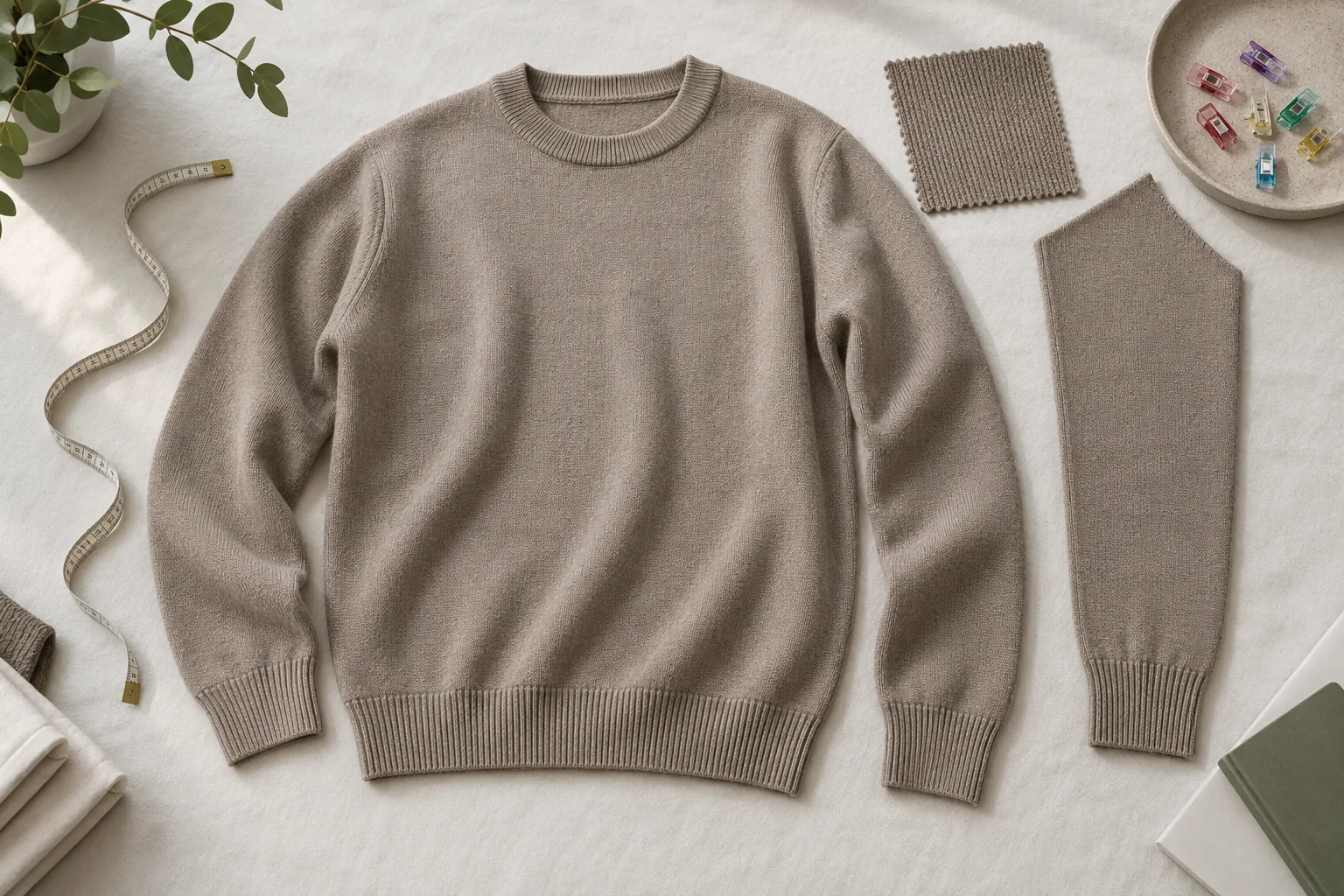
Which sample answers the first decision?
A sample should answer the highest-risk decisions before the buyer commits material or production time. Confirm yarn identity, hand, construction, fit, colour route and the intended bulk differences. A sample made from substitute stock can support a fit decision, but it cannot approve the final shade or prove bulk material availability.
Request the sample fee, deliverables, starting conditions, revision allowance, shipping and treatment after a bulk order in writing. These terms vary by supplier and project. Tie comments to a coded sample and one consolidated revision. The sampling checklist helps close open items before bulk release.
Which records must carry into bulk?
Complex construction needs more explicit gates, not a generic longer timeline. Identify which trial proves program feasibility, which proves appearance and which proves fit. Record what changes between sample and bulk, including yarn lot, machine route and finishing. The sample-to-bulk stability guide supports that comparison.
How Do Lead Time, Quality and Refills Change?
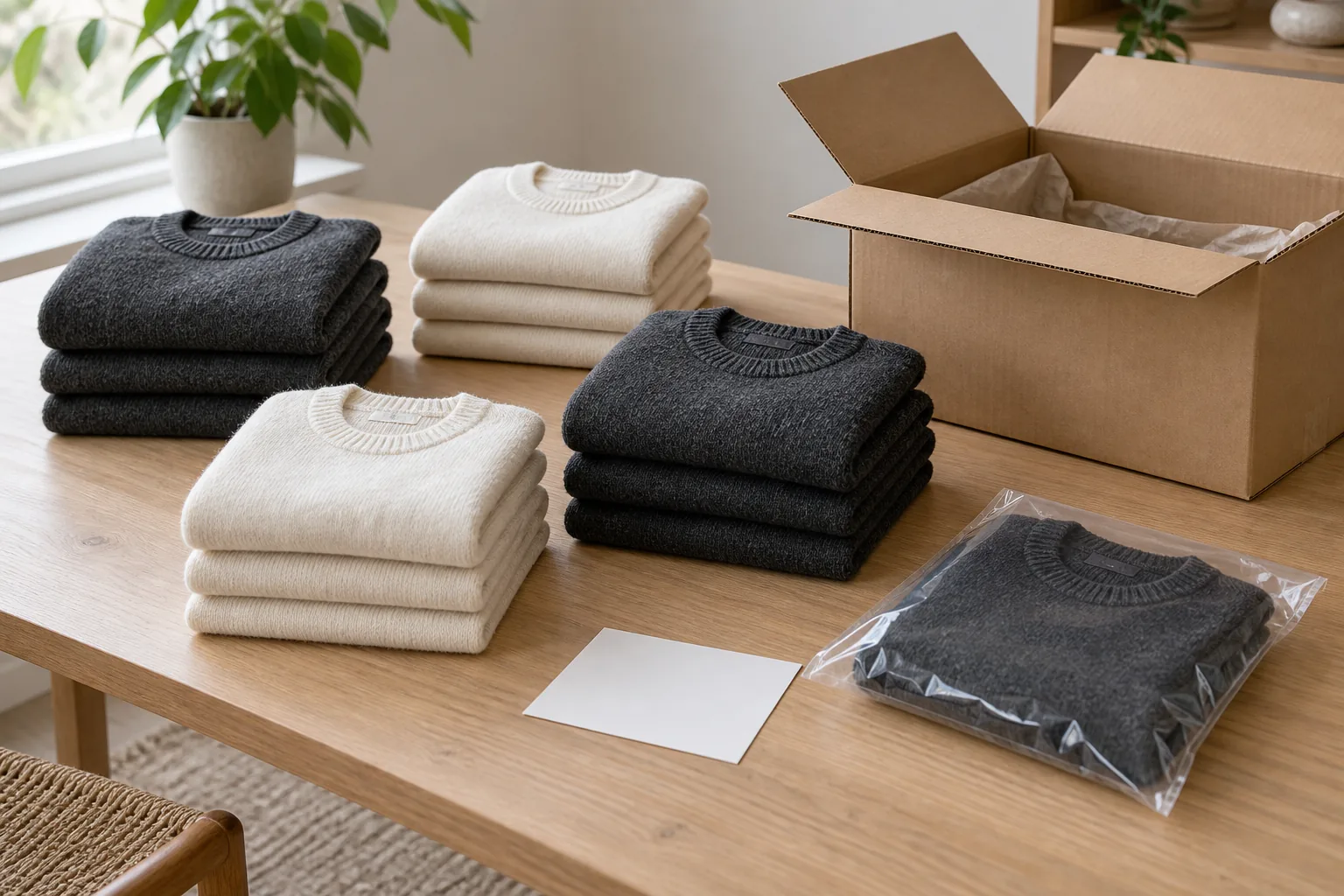
Pricing is only one side of the low-MOQ conversation. Lead time, QC, and replenishment behavior shift too, and in ways that are easy to miss if you have only sourced larger volumes before.
Lead time expectations for 50 to 300 pcs orders
A smaller quantity does not automatically mean a shorter lead time. Material procurement, colour approval, sample closure, knitting, linking, finishing, inspection and freight still occur. Ask for a stage plan with starting conditions and current capacity. Do not compare lead-time promises unless both suppliers start from the same approval and material status.
Capacity and material availability change over time. Request a dated production window and identify the decision deadline that protects it. If the order misses that date, ask which stage moves and whether the delivery still serves the selling plan. The lead-time planning guide helps record dependencies.
QC trade-offs on short runs
Quality control should be defined for the actual lot. Agree the inspected quantity basis, defect classes, measurement method, sample identity and release authority before production. A short run does not justify skipping inline checks, and a final label alone does not explain how a finding was corrected.
Put critical requirements in one controlled specification before production starts. Identify measurements, workmanship, shade, labelling and packing checks, plus the response to a failed result. Intertek describes textile inspection across production stages; use the stages to decide when evidence is needed, without treating an inspection as proof of every property.
Refill and replenishment logic
A repeat order may reuse approved information, but the supplier should first declare what remains current. Check yarn article and lot, colour route, program revision, retained sample, labels, packing and production window. Reuse is a decision based on unchanged inputs, not an automatic discount or delivery promise.
A refill can diverge when yarn, dye lot, finishing, machine route or trim changes. Request a current first-off or affected reapproval when needed. The bulk consistency guide helps connect retained standards with a new lot.
Which Low MOQ Supplier Fits Your Volume?
Not every factory is built for low-MOQ work, and not every supplier claiming low MOQs can deliver it responsibly. The selection question is less about who offers the smallest number and more about who can hold quality, lead time, and price at the volume you actually need.
Red flags when a supplier promises unusually low MOQs
Some warning signs are worth taking seriously:
- A “10-piece MOQ” on fully custom constructions with custom-dyed yarn, at a price that looks similar to bulk. Someone is absorbing a loss, which rarely ends well for either side.
- No clear sampling process or sample fee. Factories that skip sampling to win the order often skip steps in bulk too.
- Vague answers on yarn source or mill name. Yarn traceability matters for compliance, consistency, and refills.
- No willingness to share factory audit or compliance documentation on request.
A supplier should explain how the proposed minimum is supported and which conditions could change it. Look for a dated material check, a defined production route, sample deliverables and a clear cost scope. Treat an unusually low number without those inputs as an unresolved quotation, not as proof of flexibility. The OECD garment supply-chain guidance supports an ongoing, relationship-level due-diligence approach.
Questions to ask before placing a trial order
A focused first conversation is worth more than a long RFQ. Useful questions to have ready:
- What is your realistic MOQ on stock yarns versus custom-dyed yarns for this construction?
- How is the sample fee structured, and is it refundable against bulk?
- What is your typical lead time for 100 and 300 pieces respectively on this style?
- How do you handle inline and final inspection, and what AQL level do you work to?
- If this style sells through, what is the realistic lead time and minimum for a refill?
Record the answers beside the proposed order. Compare the same yarn, colour split, size range, sample route, inspection scope and delivery basis. The supplier comparison guide provides a consistent evidence matrix for shortlisted suppliers.
When nearshoring or domestic stock programs make more sense
Overseas, nearshore and available-stock routes should be compared on the same landed-cost and service basis. Include material and garment commitments, development, freight, duties, handling, inventory exposure and replenishment response. The ICC Incoterms overview helps define delivery responsibilities, but it does not set product quality or total landed cost.
A hybrid route can be useful when planned custom production and rapid replenishment solve different needs. Define which styles belong to each route, how quality standards are compared and whether colours or labels must coexist. Do not assume the channels are interchangeable until the product and delivery evidence match.
Conclusion
Low MOQ wholesale knitwear suppliers should be compared by the evidence behind the order, not the smallest number in a sales message. Lock the yarn route, colour split, size plan, sample gates, inspection scope and delivery basis. Then compare the total commitment and the conditions that would change it.
A disciplined first order limits the variables being tested. Choose whether the priority is fit, colour, construction, price or replenishment, and build the assortment around that decision. Before a repeat, verify current material and capacity rather than assuming the first quotation continues unchanged.
Destination requirements also belong in the release brief. The FTC clothing and textiles guidance and the EU textile fibre labelling regulation are primary references for their markets. Confirm current applicability for the product and destination. To review a small-order brief, contact the CNSweaters team with your yarn, colour, size and delivery inputs.
Frequently Asked Questions
What is a realistic MOQ for a custom sweater order from a China factory?
No universal number applies. Ask for the minimum by style, colour, yarn article, size split and trim, then identify whether material, production setup or supplier policy creates it. Confirm the dated answer in the quotation.
Can I mix multiple colors or sizes within one MOQ?
Possibly, when the proposed mix shares the yarn, construction and production route the supplier uses to set the minimum. Ask which elements can be combined and which remain separate commitments before changing the assortment.
How much does sampling cost and is the fee refundable?
Fees, included revisions, shipping and any bulk-order credit vary by supplier and project. Request the amount and conditions in writing. A fee should name the sample deliverables and decisions it is intended to close.
How long does a small knitwear order typically take?
Ask for a stage plan starting from complete specifications, confirmed material and approved samples. Quantity is only one input; yarn, colour approval, construction, finishing, capacity and freight can control the date.
Is one larger order always cheaper than split orders?
A larger run may spread setup work, but it also increases inventory and material exposure. Compare total committed cost, delivery timing, residual yarn and sell-through risk. Use the same scope for every scenario.